What is on the page
- Period and balance sheet date
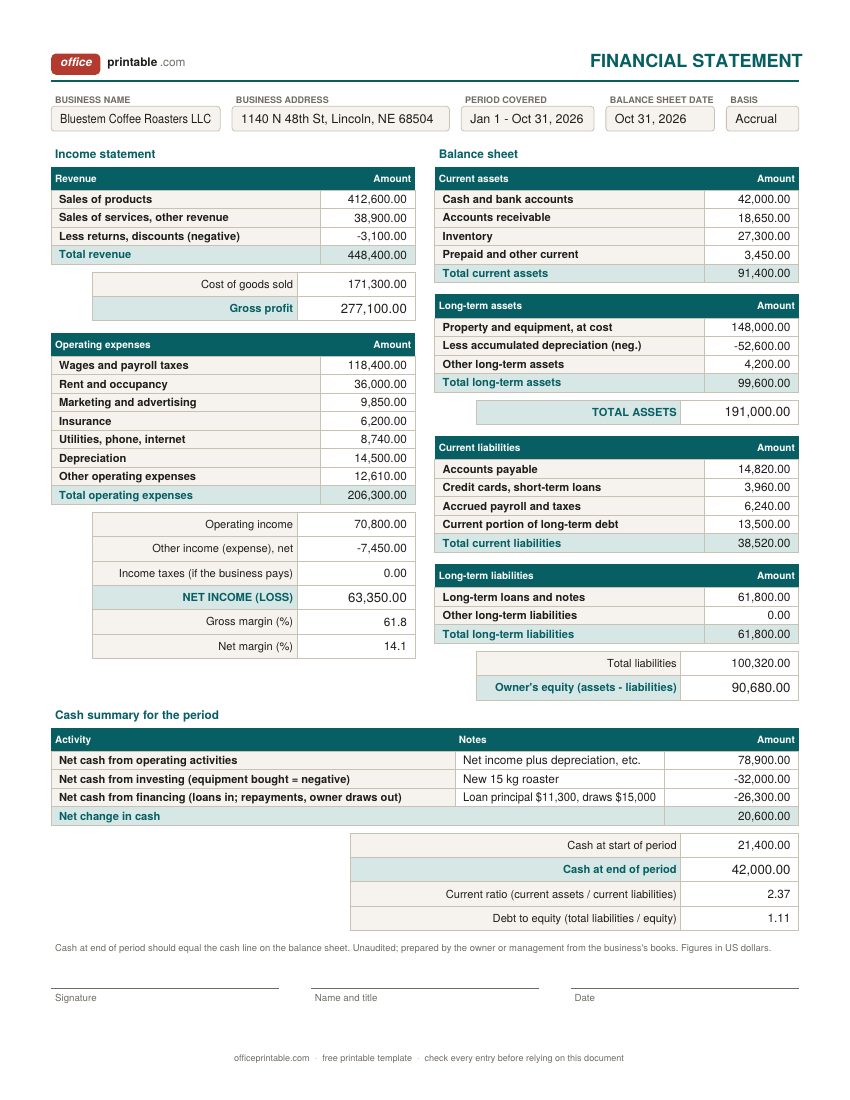
- The income statement covers a stretch of time (a year, a quarter, January through October). The balance sheet is a snapshot on one date, normally the last day of that period. Write both, plus whether the books are kept on the cash or accrual basis.
- Revenue and cost of goods sold
- Sales less returns and discounts, then the direct cost of what was sold. Revenue minus cost of goods sold is gross profit. Service businesses often leave cost of goods sold at zero.
- Operating expenses and net income
- The overhead lines in condensed form. Add other income or expense (interest paid on loans is the usual one, entered as a negative) and income tax if the business itself pays it, and Excel gives net income and both margins.
- Assets, liabilities and owner's equity
- Current items first (cash, receivables, inventory; bills due within a year), then long-term ones. Equity is worked out for you as assets minus liabilities, so the two sides always match. The real check is whether the cash line agrees with the cash summary below it.
- Cash summary
- Start-of-period cash, the net cash from operating, investing and financing activities, and ending cash. Equipment purchases go in as negatives under investing. Loan proceeds are positive and repayments and owner draws negative under financing.
- Personal assets and liabilities
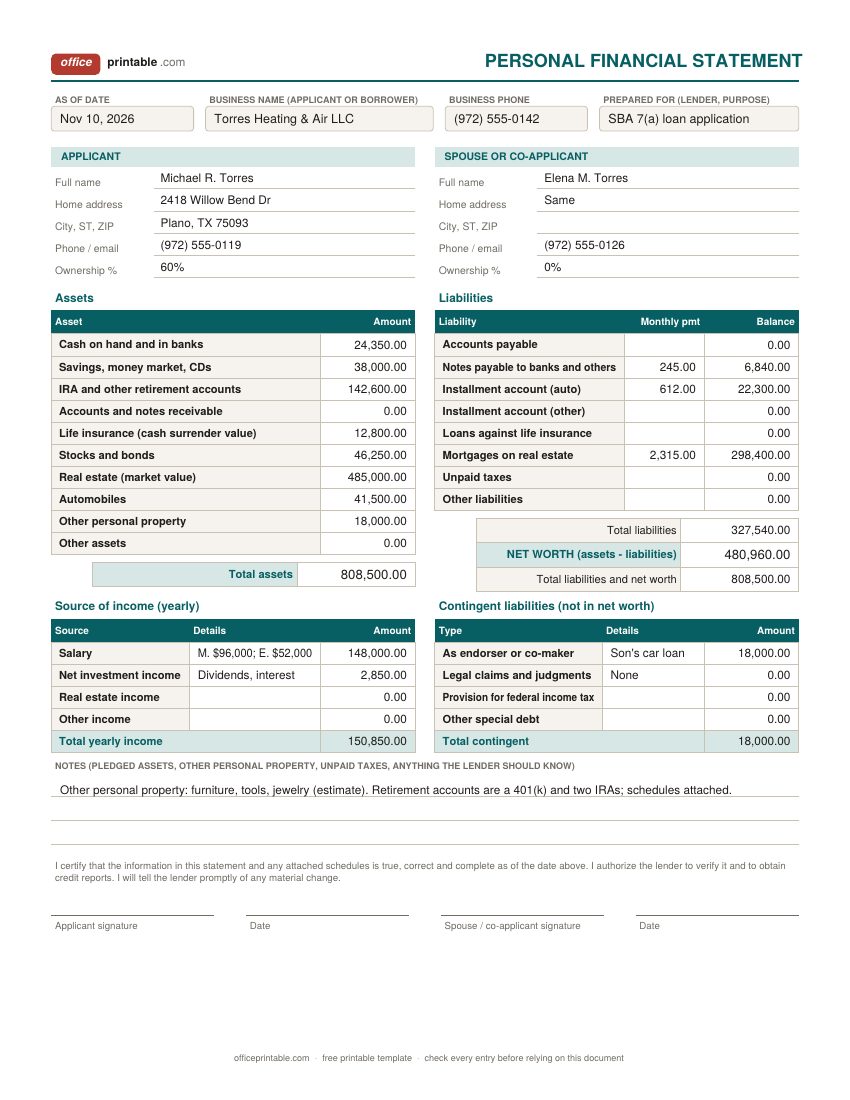
- The same line items, in the same order, as SBA Form 413 and most bank forms. Use today's market value for property, vehicles and investments, and only the cash surrender value of life insurance.
- Source of income and contingent liabilities
- Yearly income by type, and debts you could become responsible for, such as a loan you co-signed. Contingent liabilities are listed for the lender but left out of net worth.
- Certification and signature
- Each person signs and dates the statement. A lender relies on it, so a deliberately false figure can carry legal consequences.
A small business financial statement on one page
A full set of financial statements usually means three reports: an income statement, a balance sheet and a statement of cash flows. In accounting software they sit on seperate linked tabs. These downloads are single-sheet files, so the business design is a one-page summary instead of a tabbed workbook. Everything sits on that one sheet: income statement on the left, balance sheet on the right, cash summary at the bottom. The formulas tie them together. Total revenue feeds both margins, total liabilities feed owner's equity, and the ratios at the bottom pull from the balance sheet.
For most small businesses that's what a lender, landlord or partner wants to see first. When someone asks for the full detail, use the dedicated pages. The profit and loss statement template has the full expense list and a 12-month view. The balance sheet template breaks out every asset and liability line. The cash flow statement template builds operating cash from net income step by step. Day-to-day transactions belong in the accounting ledger template. This summary is where the totals from those pages end up.
Personal financial statement template for bank and SBA loans
When a small business borrows, the lender nearly always wants a personal financial statement from the owners too. Many banks have their own form. The SBA has its own as well: SBA Form 413, used for 7(a), 504 and disaster loans and for some SBA certification programs. For SBA loans it is usually required from each owner holding 20% or more of the business (counting what a spouse and minor children own), and the figures include the spouse's assets and debts.
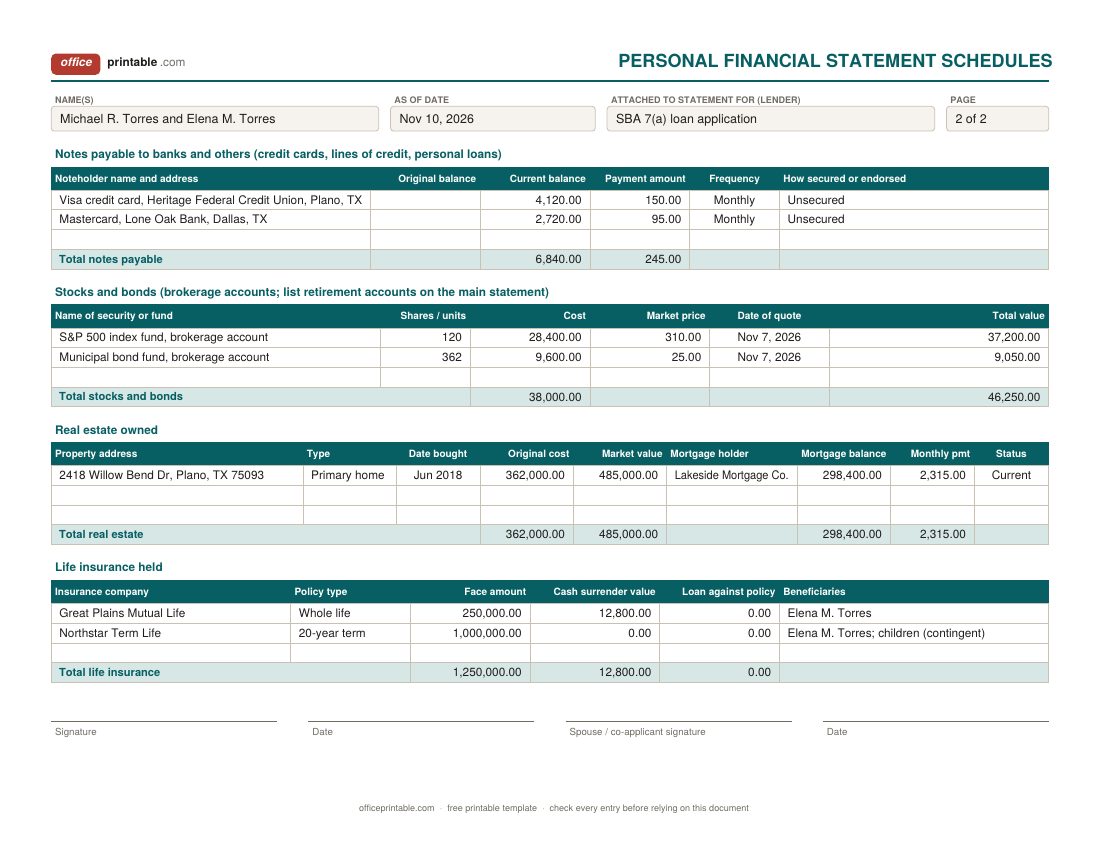
The personal design on this page follows the same order as Form 413 and most bank versions. Assets run from cash down to other assets. Liabilities run from accounts payable to other liabilities, with a column for monthly payments. Then come yearly income, contingent liabilities and a signed certification. The schedules sheet holds the detail lenders ask for behind the big numbers: who you owe and on what terms, which securities you hold, each property with its mortgage, and life insurance policies. Use it to gather and check your numbers. If your lender insists on its own form or on the official SBA one, copy the figures across; the order matches, so it takes a few minutes.
How to fill in the small business statement
- Pick the period and the balance sheet date, usually the last day of the most recent month or year. Note cash or accrual basis.
- Take revenue, cost of goods sold and expenses from your books or the profit and loss report. Enter returns and discounts as a negative.
- Enter interest on business loans under other income (expense) as a negative. Leave income tax at zero for a sole proprietorship, partnership or most LLCs, where the owners pay the tax on their own returns.
- Fill the balance sheet from bank statements, your receivables list, an inventory count and loan statements. Accumulated depreciation goes in as a negative.
- Enter starting cash and the three cash activity totals. The ending cash figure Excel calculates should equal the cash line on the balance sheet. If it doesn't, a transaction is missing or sits in the wrong place.
- Sign and date the statement, then keep a PDF copy with the period in the file name.
How to complete a personal financial statement
Start with recent statements: checking and savings, brokerage, retirement, mortgage, auto loans and credit cards. Use balances as of one date and write that date at the top. Property goes in at what it would sell for today, not what you paid. A recent appraisal, a county assessment or comparable sales are fair starting points. Vehicles go in at a used-car pricing guide value. Life insurance counts only for its cash surrender value. A term policy has none, so it appears on the schedule but adds nothing to assets.
Retirement accounts go on the IRA and other retirement line. Some lenders like to see them separate, since they're often hard to reach before retirement. Your ownership in the business that's borrowing is usually left off or listed separately; ask the lender which they prefer. Contingent liabilities are easy to forget. A co-signed loan for a child, a personal guarantee on another business's lease or a pending lawsuit all belong there. Leaving one off and having the lender find it on a credit report does far more harm than listing it.
Checks before you hand it over
- On the business statement, total liabilities and equity equals total assets. That's built in, so look at equity itself: a negative figure is something a lender will ask about.
- Ending cash in the cash summary agrees with the balance sheet cash line.
- On the personal statement, the schedule totals match the main lines: stocks and bonds, real estate value, mortgage balances, notes payable and life insurance cash value.
- The date is recent. For SBA loans the figures generally have to be current within roughly 90 to 120 days of submission depending on the program, and banks set their own limits, so check with your lender.
- Both spouses sign where the lender asks for it, and the copy you keep matches the one you sent.
To track personal net worth from year to year without a lender in the picture, the net worth worksheet is simpler. For planning cash in the months ahead, rather than reporting the past, use the cash flow planner. If the statement is going into a loan package, the business plan template and the loan amortization schedule usually go with it.
Questions
What are the main types of financial statements?
The income statement (profit and loss) shows revenue, expenses and profit over a period. The balance sheet shows assets, liabilities and equity on one date. The cash flow statement shows where cash came from and went. Larger companies add a statement of changes in equity and notes. A small business summary like the one here condenses the first three onto a single page.
What is a personal financial statement used for?
Lenders use it to judge whether an owner or guarantor could repay a loan if the business could not. Banks, the SBA, commercial landlords and some surety and franchise companies ask for one. It lists what you own, what you owe, your yearly income and any debts you might have to cover for someone else.
Is a personal financial statement the same as a net worth statement?
They overlap. Both list assets and liabilities and arrive at net worth. A personal financial statement adds yearly income, contingent liabilities, supporting schedules and a signed certification, because a lender will rely on it. For your own records the simpler net worth worksheet is enough.
Who has to sign SBA Form 413?
For SBA loans it's generally each owner with 20% or more of the business, counting holdings of a spouse and minor children, plus general partners, managing members and anyone giving a personal guarantee. Rules differ a little by program, so ask the lender which people need to sign.
Do small business financial statements have to be prepared by a CPA?
Not usually for a small loan or a lease. Owner-prepared statements are common and should say they're unaudited. Larger loans or certain lenders may ask for statements a CPA has compiled, reviewed or audited, plus tax returns to back them up. Check with your lender before you start.
Can I use the Excel file in Google Sheets?
Yes. Upload the .xlsx file to Google Drive and open it with Google Sheets. The sums, margins and ratios carry over. The fillable PDF works in free PDF readers if you would rather type into a form.
Comments and questions
Have a question about this template, or an idea to make it better? Leave a comment.
Leave a comment