What is on the page
- Company and period
- The business name and the exact period, for example "Year ended Sep 30, 2026" or "Quarter ended Sep 30, 2026". It always covers a span of time; a balance sheet shows a single date.
- Operating activities
- Cash from the main business: collections from customers, payments to suppliers and staff, rent, interest and income taxes. Under US GAAP, interest paid and received and income taxes paid all go in this section.
- Investing activities
- Buying and selling long-term assets such as equipment, vehicles, buildings and investments, plus loans the business makes to others.
- Financing activities
- Money from or back to lenders and owners: loan proceeds, principal repayments, owner contributions, draws, distributions and dividends paid.
- Beginning and ending cash
- Cash and cash equivalents at the start of the period, plus the net change, gives cash at the end. Ending cash should match the balance sheet (or the bank statement on the monthly version). The Difference line shows any gap.
- Supplemental information
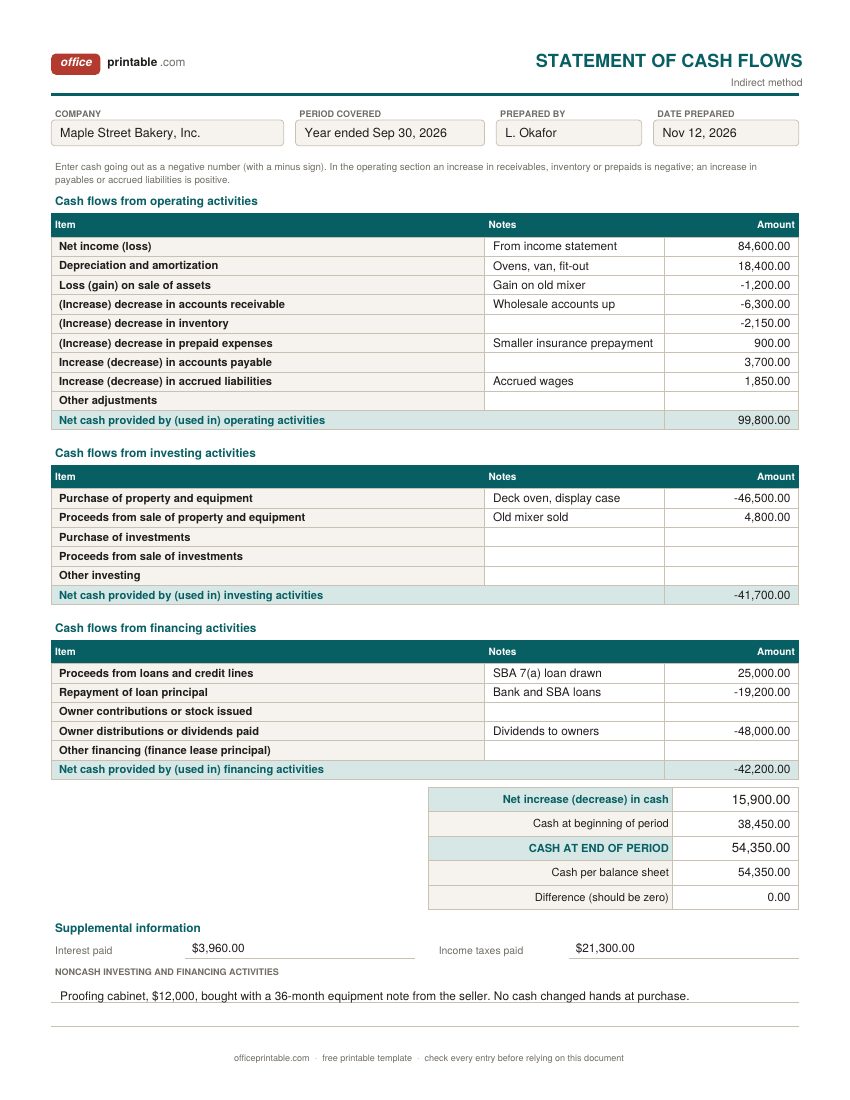
- On the indirect version: interest paid and income taxes paid, plus a note of any noncash investing or financing deals, such as equipment bought with a seller note.
- Reconciliation
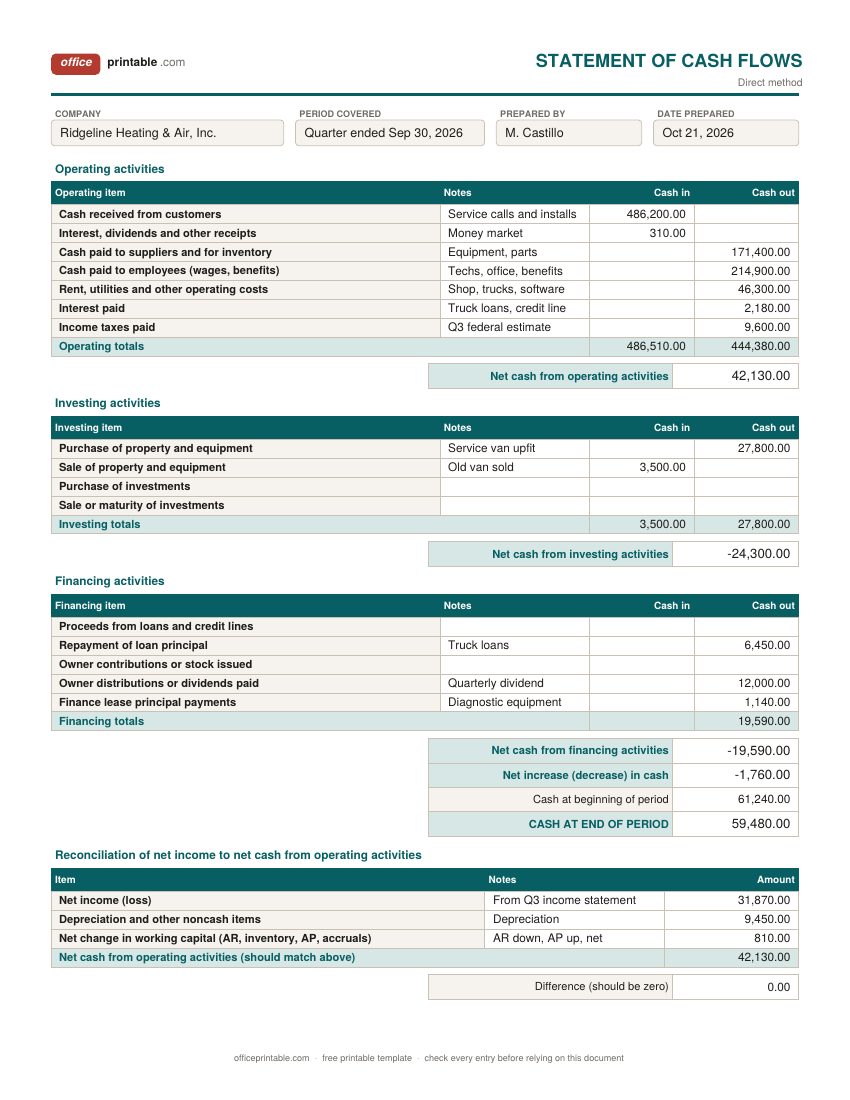
- On the direct version: net income, noncash items and working capital changes, which should add up to the same operating cash figure as the section above.
What goes in each section of a cash flow statement
The statement of cash flows has a fixed shape. Every cash movement lands in one of three sections, and the three totals add up to the change in cash for the period.
Operating activities are the day to day: money from customers, money paid to suppliers, staff, the landlord and the tax authorities. Investing activities are long-term assets. A new oven, a delivery van, a building, or shares bought as an investment are investing outflows; selling the old van is an investing inflow. Financing activities are the owners and the lenders: a loan coming in, principal going back, money an owner puts in, and dividends or draws taken out.
A few items trip people up. Interest paid on a loan is operating under US GAAP, even though the loan principal is financing. Dividends paid are financing. Interest and dividends received are operating.
How to fill in the cash flow statement template (indirect method)
The indirect method is what most companies, large and small, use because it builds the statement from records you already have: an income statement for the period and balance sheets at the start and end.
- Enter net income from the profit and loss statement for the same period.
- Add back depreciation and amortization. They reduced profit but no cash left the business.
- Take out any gain on selling an asset, or add back a loss. The full sale proceeds show up in investing instead.
- Work through the working capital lines using the two balance sheets. If accounts receivable went up, customers owe you more and you collected less cash than you booked as sales, so the increase is negative. If accounts payable went up, you held on to cash, so the increase is positive. Inventory, prepaids and accrued liabilities follow the same logic.
- List the investing items: equipment bought (negative), sale proceeds (positive).
- List the financing items: new loans (positive), principal repaid, dividends or distributions paid (negative).
- Enter cash at the beginning of the period. Excel adds the sections, works out ending cash and compares it with the figure you type from the balance sheet.
A balance sheet template for both dates makes step 4 much faster. In the bakery sample, receivables rose by $6,300 during the year, so that line reduces operating cash by $6,300 even though the sales were already counted in net income.
Direct method: cash receipts and payments
The direct method lists the operating cash that actually came in and went out: cash received from customers, cash paid to suppliers, cash paid to employees, interest paid and taxes paid. Most readers find it easier to follow, and the FASB encourages it.
The catch is that US GAAP still asks for a reconciliation of net income to operating cash flow when you use the direct method. That's why the direct design has a short reconciliation block at the bottom. In the HVAC sample, net income of $31,870 plus $9,450 of depreciation plus $810 from working capital gives $42,130, the same figure as the operating section above it. If the two do not match, a receipt or payment has been missed or put in the wrong section.
Investing and financing look the same under both methods. Only the operating section changes.
The monthly cash in and out statement
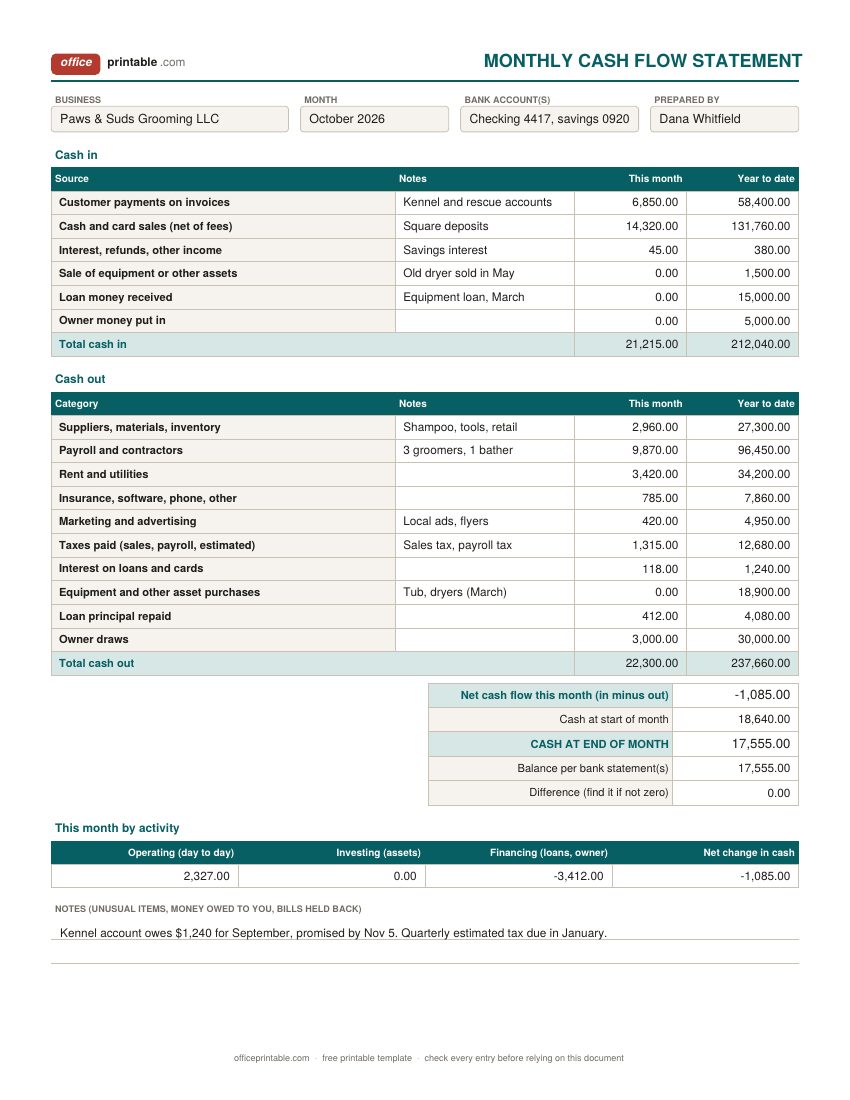
Many small businesses keep cash-basis books and never prepare a formal statement of cash flows. For them the simple monthly design is the practical version: what came in, what went out, and whether the ending figure agrees with the bank. It looks back at a month that's over. Each line has a this-month and a year-to-date column, and the small table at the bottom splits the month into operating, investing and financing. In the grooming shop sample, the business made $2,327 from operations in October but paid $412 of loan principal and took $3,000 in owner draws, so cash fell by $1,085. That's a good thing to know before the owner raises the draw.
If the bank difference line isn't zero, look for a deposit or payment you missed, a transfer between accounts counted twice, or a card fee taken out of a deposit.
Cash flow statement vs cash flow forecast
The two get mixed up all the time. A cash flow statement reports actual cash movements for a period that has ended. It is one of the core financial statements, alongside the income statement and the balance sheet, and it's what a lender, investor or accountant expects to see with year-end accounts. A cash flow forecast looks ahead and estimates what will come in and go out over the next weeks or months so you can spot a shortfall early. For that, use the cash flow planner which has 12-month and 13-week forecast sheets. Many owners use both: the forecast to plan, the statement to see how close the plan was.
If you need the full set of year-end statements on linked tabs, the financial statement template puts the income statement, balance sheet and cash flow statement in one workbook.
Using the cash flow statement template in Excel
In the Excel files every section total, the net change and the ending cash are formulas, so you only type the line items and the beginning cash. On the indirect design, type cash going out as a negative number; on the direct design use the Cash in and Cash out columns and leave the signs alone. Rename row labels to match your chart of accounts; rows inserted inside a section are picked up by the totals. The Difference lines are your check: they should read zero, or stay blank, once the statement is complete.
The fillable PDF works the same way on screen but does not calculate, so add the sections by hand or fill the Excel file first and copy the totals across. This template follows general US GAAP layout. For statements going to a bank, investors or the IRS, or anything involving leases, foreign currency or unusual transactions, check the presentation with your accountant or CPA.
Questions
What are the three sections of a cash flow statement?
Operating activities (cash from running the business), investing activities (buying and selling long-term assets and investments) and financing activities (loans, owner contributions and payouts to owners). Their totals add up to the net increase or decrease in cash for the period.
Should I use the direct or the indirect method?
Both are allowed under US GAAP. The indirect method is more common because it starts from net income and the balance sheet, which most bookkeeping systems already produce. The direct method is easier to read and is encouraged by the FASB, but you still need a reconciliation from net income. Ask your accountant which one your lender or investors expect.
Why is depreciation added back?
Depreciation lowers net income but no money leaves the bank when it's recorded. The cash went out when the asset was bought, and that purchase shows up in investing activities in the period you paid for it.
Where do owner draws and loan payments go?
Owner draws, distributions and dividends paid are financing outflows. A loan payment is split: the principal is financing, and the interest is operating under US GAAP. Your lender's statement or a loan amortization schedule shows how much of each payment is interest.
My ending cash does not match the balance sheet. What now?
Check that beginning cash is the ending figure from the previous period, that every balance sheet change has a line, that asset sales show the full proceeds in investing (and the gain is taken out of operating) and that no noncash deal, like equipment bought with a seller note, was entered as cash. If you include restricted cash in the total, include it at both ends.
Comments and questions
Have a question about this template, or an idea to make it better? Leave a comment.
Leave a comment