What is on the page
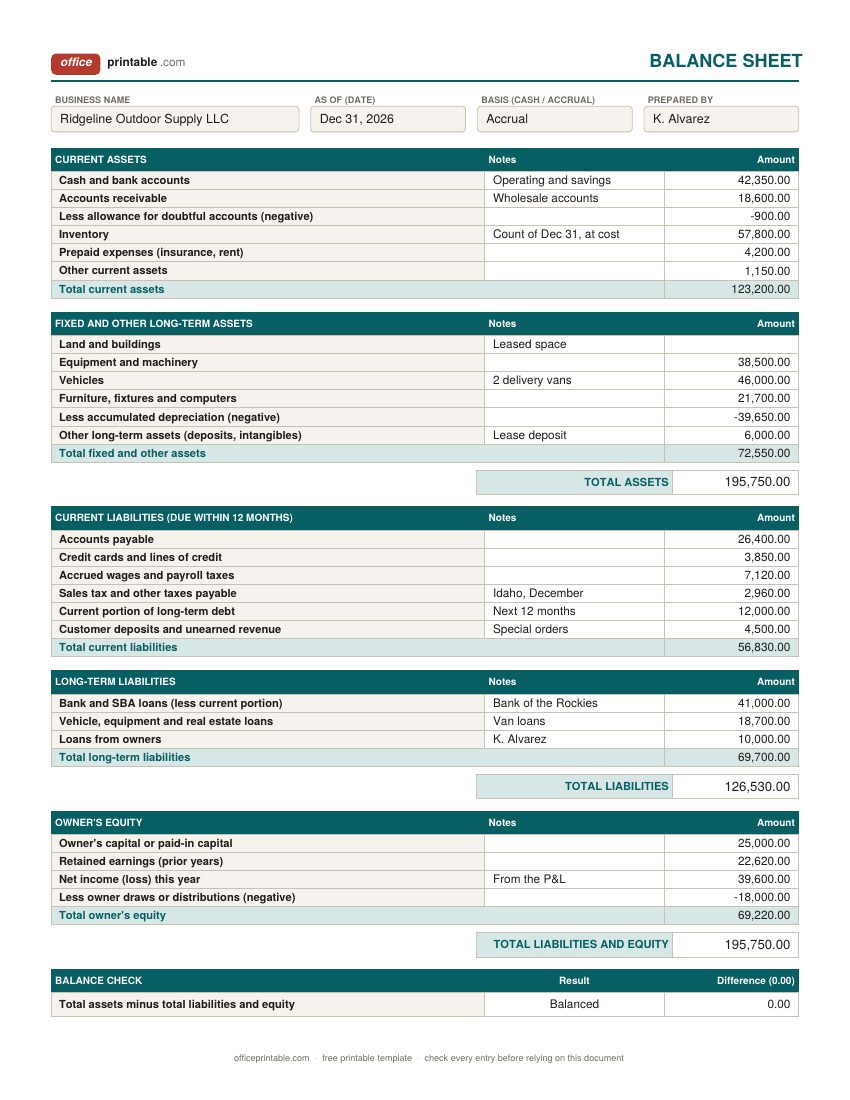
- As-of date
- A balance sheet describes one day, usually the last day of a month, quarter or year. Use the same date your bank statements and inventory count use, so the figures line up.
- Basis
- Cash basis or accrual. On the cash basis you usually leave out receivables, payables and accrued wages, because nothing is recorded until money moves. Say which one you used.
- Current assets
- Cash and anything you expect to turn into cash within a year: receivables from customers, inventory, prepaid insurance or rent. Bad debts you expect not to collect come off as an allowance.
- Fixed assets
- Land, buildings, equipment, vehicles, furniture and computers at what you paid for them, less accumulated depreciation. Land is never depreciated.
- Current liabilities
- Bills, card balances, wages and taxes owed, customer deposits for work you have not done yet, and the part of any loan due in the next 12 months.
- Long-term liabilities
- The rest of your loans, after taking out the current portion. Money an owner lent the business goes here too, on its own line, so it is not confused with the owner's capital.
- Owner's equity
- What the owners put in, plus profits left in the business, minus what they took out. On the detailed design this year's net income comes straight from your profit and loss statement.
- Balance check
- Total assets minus total liabilities and equity. It should be zero. The Excel files say "Balanced" or "Out of balance" so you never send out a sheet that does not tie.
What a balance sheet shows
Every balance sheet rests on one equation: assets = liabilities + owner's equity. Think of it as two views of the same pile of money. The left side lists what the business has. The right side shows who has a claim on it: lenders and suppliers first, the owners after them. If you sold everything at book value and paid off every debt, owner's equity is roughly what would be left.
Because it's a snapshot, a balance sheet doesn't tell you how the business did over the year. That's the job of the profit and loss statement. The two connect through equity. Net income from the P&L, less what the owners took out, is the change in retained earnings from one balance sheet to the next.
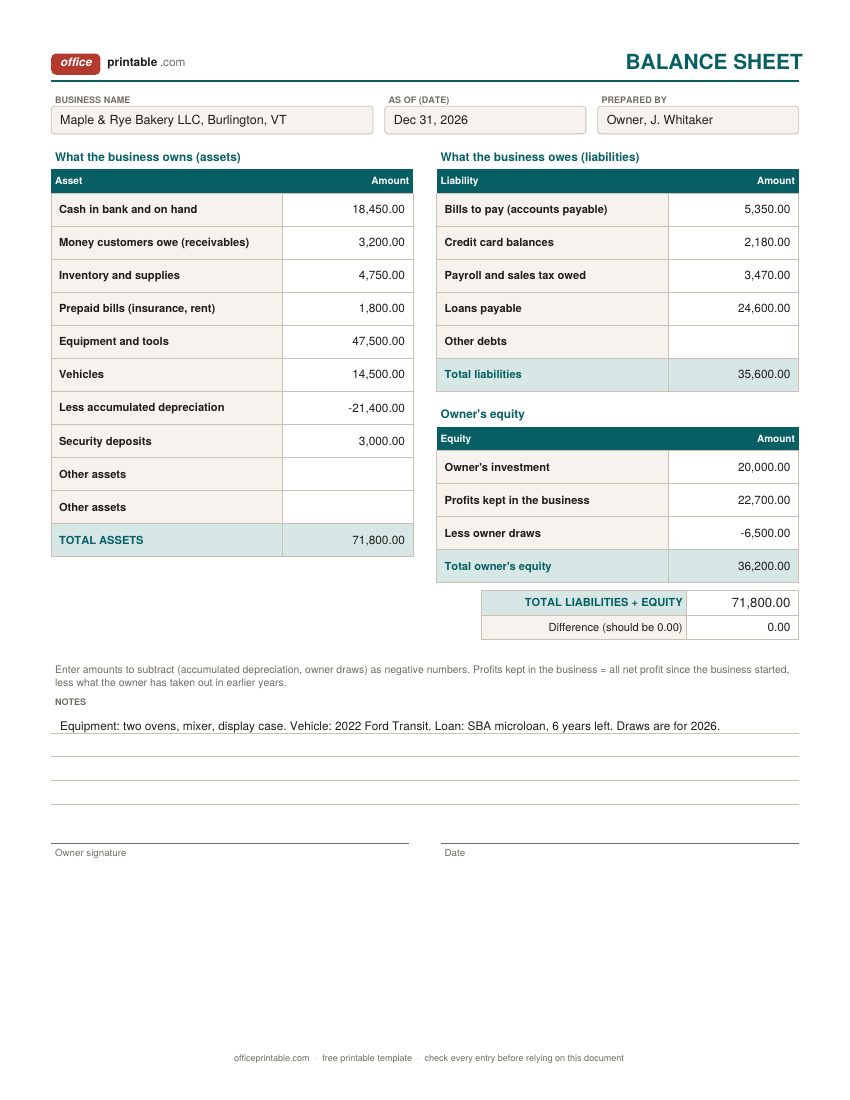
There are two common layouts, and both are correct. The report form stacks assets on top and liabilities and equity below. It suits a page in portrait and leaves room for notes, so the small business and comparative designs use it. The account form puts assets on the left and liabilities and equity on the right, like the two sides of a T-account. That is the layout of the simple balance sheet template here.
Inside each side the order follows a convention. Assets run from most liquid to least: cash, receivables, inventory, prepaid items, then fixed assets. Liabilities run from soonest due to latest. A banker reading the sheet expects to find things in that order, so it's worth keeping even if you rename the lines.
How to fill in the balance sheet template
- Pick the date. Month end or year end is easiest because statements and payroll reports already stop there.
- Cash. Use the reconciled bank balance, not the number in the app that morning. Add petty cash if you keep any.
- Receivables and inventory. Total the unpaid invoices from your billing tracker. Count inventory and value it at cost, not at the price you sell it for.
- Fixed assets. List each at what you paid. Put total depreciation taken so far on the accumulated depreciation line as a negative number. Your tax return's depreciation schedule (Form 4562 and the preparer's worksheets) is the usual source.
- Liabilities. Take loan balances from the lender's statement on the same date and split out the next 12 months of principal as the current portion. A loan amortization schedule makes that split easy. Add unpaid bills, card balances, wages earned but not paid, and sales tax collected but not yet sent to the state.
- Equity. Enter what the owners invested, profits kept from earlier years, this year's net income and the year's draws as a negative.
- Check. Look at the balance check line. Zero means the sheet ties.
When the balance sheet does not balance
An out-of-balance sheet almost always comes down to one of a handful of slips. Draws or depreciation typed as positive numbers is the most common one in a template like this. A loan entered at its original amount instead of today's balance is another. Equipment bought during the year sometimes goes on the sheet twice: once as equipment, and again inside a cash figure taken from before the purchase. Owner money is the other frequent problem: a personal payment for a business bill is an owner contribution and belongs in equity.
If the difference is exactly twice one of your numbers, that line probably has the wrong sign. If it's divisible by 9, look for two swapped digits. And if you keep books on the cash basis but typed receivables in, the sheet won't tie to your P&L. With bookkeeping software, run its balance sheet report for the same date and compare it line by line. If the difference is still there, ask your bookkeeper or accountant.
Balance sheet example: reading the numbers
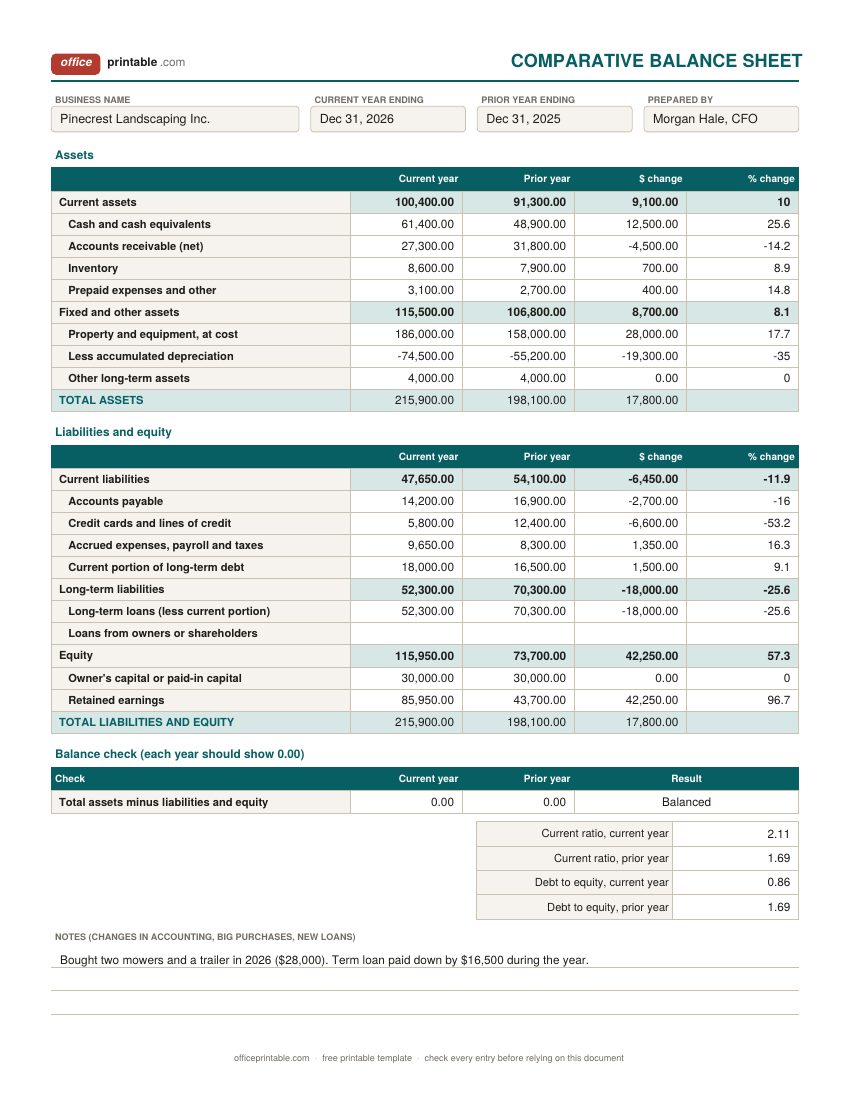
The previews above show a balance sheet example for each design. On the comparative one, Pinecrest Landscaping has $100,400 in current assets against $47,650 in current liabilities. That gives working capital of $52,750 and a current ratio of 2.11, up from 1.69 a year earlier. A current ratio above 1 means the bills due this year are covered by assets that turn into cash this year. Debt to equity (total liabilities ÷ total equity) fell from 1.69 to 0.86 because the company paid down its long-term loan and kept most of its profit in the business.
Lenders look at both ratios, but what counts as healthy depends alot on the industry. A grocery store and a software firm will never look alike. Compare your own numbers year over year first, then against businesses like yours. Your accountant or banker can tell you what a lender in your field expects.
Who needs a balance sheet, and how often
A sole proprietor files Schedule C, and Schedule C has no balance sheet, so many small owners never make one. Then a bank asks for it. Lenders, including banks making SBA loans, usually want a recent business balance sheet with the application, and landlords, investors and buyers of a business often ask too. Corporations and partnerships report a balance sheet on their tax return (Schedule L), although smaller ones can often skip it; the thresholds differ by form, so check with your tax preparer.
Once a year is the minimum. Quarterly is better if you carry inventory or debt, because it shows trouble while there's still time to fix it. Each year, save the finished file and copy its numbers into the prior-year column of the comparative template.
Using the balance sheet template in Excel, PDF and Word
In the balance sheet template Excel files, type amounts in the plain cells. The shaded cells hold formulas for subtotals, totals, the balance check, and on the comparative design the change columns and ratios. Rename any line to suit your business; inserting a row inside a section keeps the sums working. The fillable balance sheet PDF works in a free PDF reader, but it doesn't calculate, so add up the totals yourself or use the Excel or ODS version. In Word every section is a table you can edit.
Looking for a personal balance sheet template? That's the net worth worksheet, which lists a household's home, savings, retirement accounts and debts. For the business side, the cash flow planner tracks money coming and going month by month, the business expense tracker feeds the P&L, and the break-even worksheet shows how many sales cover your fixed costs.
Questions
What is the difference between a balance sheet and a profit and loss statement?
The balance sheet shows what the business owns and owes on a single date. The profit and loss statement shows income and expenses over a period, such as a month or a year. Net income from the P&L flows into owner's equity on the balance sheet.
Why must assets equal liabilities plus equity?
Everything the business owns was paid for with borrowed money, owner money or profits kept in the business. Liabilities record the borrowed part and equity records the rest, so the two sides always describe the same total. If they differ, a number is missing or entered wrong.
Do owner draws go on the balance sheet?
Yes, as a reduction of owner's equity, not as an expense. Enter them as a negative number in the equity section. For an S corporation, the owner's salary is a wage expense on the P&L, while distributions reduce equity. Ask your accountant how your entity type should show them.
Can I make a balance sheet on the cash basis?
Yes. Many small businesses keep cash-basis books, and the balance sheet then shows mainly cash, fixed assets, loans and equity, without receivables or payables. Lenders sometimes ask for accrual figures, so check what the person asking for the sheet expects.
What is a good current ratio for a small business?
Above 1 means current assets cover current liabilities. Many lenders like to see something closer to 1.5 or 2, but norms differ by industry. Your banker or accountant can give you a better benchmark for your field.
Does the balance sheet PDF add up the totals?
No. The PDF is fillable but does not calculate. The Excel and ODS files work out every subtotal and run the balance check for you.
Comments and questions
Have a question about this template, or an idea to make it better? Leave a comment.
Leave a comment