What is on the page
- Executive summary
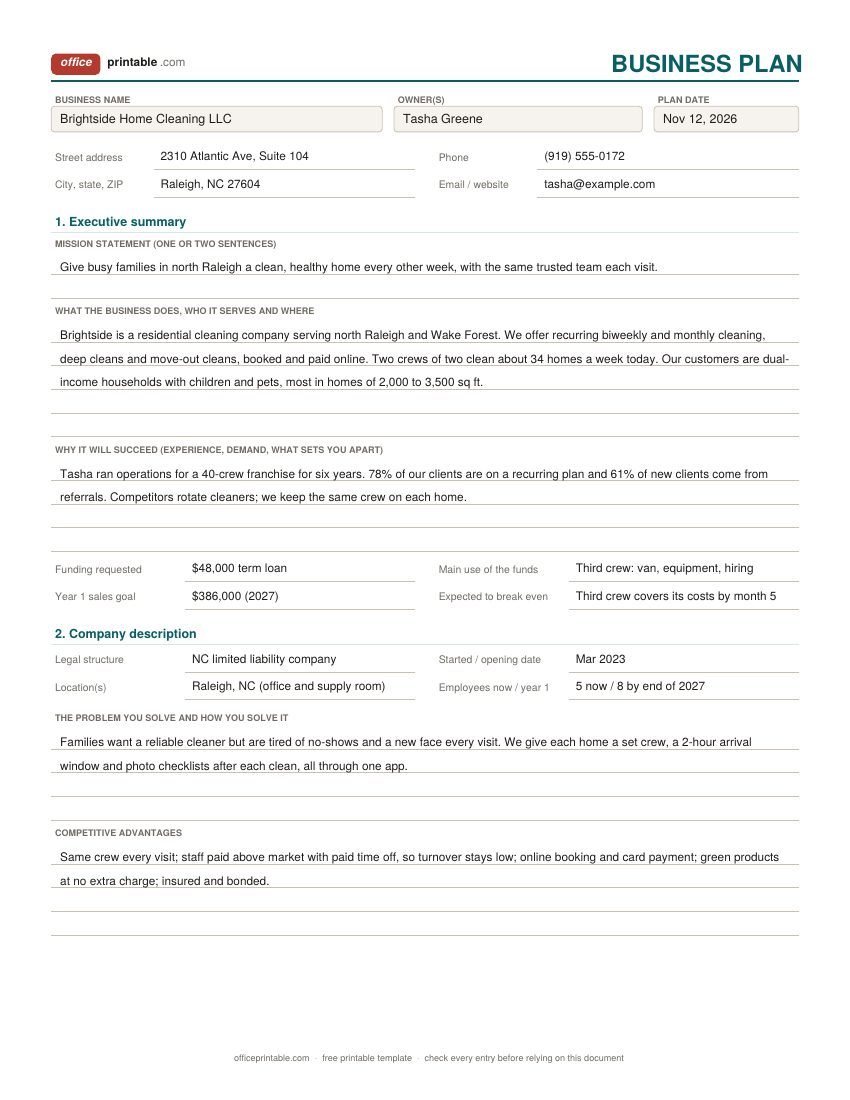
- What the business is, who it serves, why it will work and, if you need money, how much and for what. Write it last, after the rest of the plan is done.
- Company description
- Legal structure, location, start or opening date, staff, the problem you solve and what gives you an edge.
- Market analysis and competitors
- The industry, your target customers and a table of competitors with their strengths, gaps and prices.
- Organization and management
- Who runs the business, their experience and ownership share (the table totals it), plus advisers and hiring plans.
- Products, pricing and margins
- Each product or service with price and cost to deliver. Excel works out the margin on each line.
- Marketing and sales
- Channels with a monthly budget and expected new customers, the cost per new customer, your sales process and how you keep customers.
- Funding request and use of funds
- Amount, type of funding, term, owners' own money and an itemized, totaled list of where the money goes.
- Financial projections and forecast
- Sales, cost of sales, gross profit, expenses and net profit by year. The startup design adds break-even sales and cash at year end.
- Appendix
- A checklist of the supporting papers lenders often ask for: résumés, credit history, licenses, leases, contracts and financial statements.
What goes in a business plan template
A traditional business plan is a written description of your business and the numbers behind it. The U.S. Small Business Administration describes the usual sections in this order, and the fillable template follows it so a lender can find each part where they expect it:
- Executive summary. The plan in a page: what you do, for whom, why it will work, and the money you're asking for.
- Company description. The problem you solve, who you serve and what sets you apart.
- Market analysis. Your industry, your target customers and what competitors do well.
- Organization and management. Legal structure and the people who run the business.
- Service or product line. What you sell and how customers benefit.
- Marketing and sales. How you'll attract customers, close sales and keep people coming back.
- Funding request. How much you need, what kind of funding, and what you'll spend it on.
- Financial projections. The numbers that show the business can pay its way and repay a loan.
Most plans finish with an appendix of supporting documents such as résumés, credit history, licenses and permits, leases and quotes. The template ends with a tick list of those so nothing is left out of the package.
How to write a small business plan, section by section
Start in the middle, not at the top. The market analysis and the numbers decide almost everything else, so fill in those first. Write the executive summary at the very end, when you know what the plan says.
Market analysis. Be specific about the customer. "Homeowners" is too wide. "Dual-income families in north Raleigh with homes over 2,000 square feet" tells a reader you know who will pay. Count them if you can, using census data, your city, or a trade association. For competitors, write down what each one does well. A plan that claims the competition is bad at everything reads as wishful.
Products and pricing. Put the real price next to the real cost of delivering each product. The Excel file shows the margin on every line, and low-margin items stand out straight away.
Marketing and sales. List each channel with a monthly budget and the number of new customers you expect it to bring in. The template divides one by the other which gives a cost per new customer. If that number is higher than the profit on a first sale, you need repeat business to make the channel pay, and the plan should say how you will get it. The marketing planner is handy for turning this section into a month-by-month calendar.
Funding request. Itemize. "Equipment, $48,000" is weak; a list of machines with quotes attached is strong. Lenders also look at how much of your own money is going in, so fill in that line honestly.
Financial projections. The SBA guide suggests a five-year outlook with the first year broken down by month or quarter, and three to five years of past statements if the business already runs. The template has five yearly rows; build the monthly first year in a cash flow planner and attach it.
Startup business plan template with a 3-year financial forecast
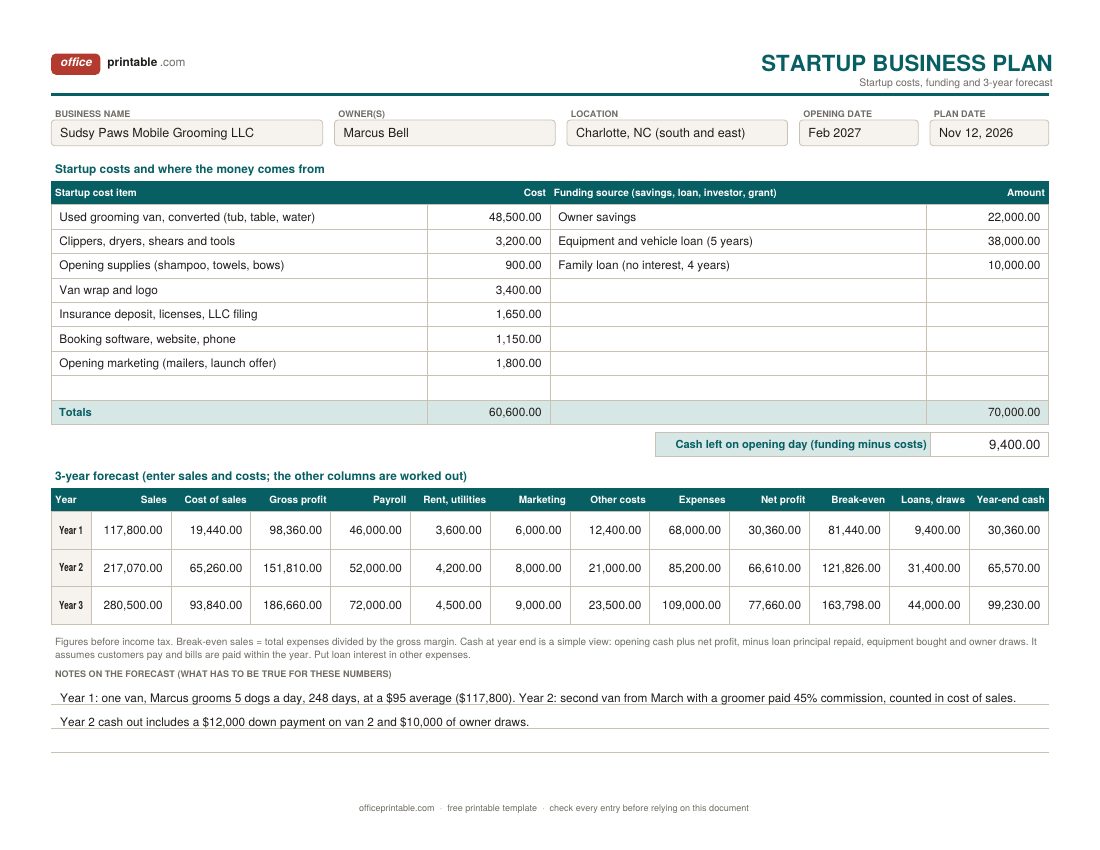
For a business that hasn't opened yet, the startup design puts the money questions first. The first table lists startup costs on the left (equipment, a vehicle or build-out, deposits, licenses, opening inventory, launch marketing) and where the money comes from on the right. Excel subtracts one total from the other to give the cash you will have on opening day.
Below that, you enter sales and costs for three years. The sheet works out:
- Gross profit: sales minus cost of sales, meaning what you pay for the goods, materials or direct labor behind each sale.
- Total expenses and net profit: payroll and owner pay, rent and utilities, marketing and other expenses, taken away from gross profit.
- Break-even sales: total expenses divided by the gross margin. Below that level of sales, the year loses money.
- Cash at year end: opening cash plus net profit, minus loan principal, equipment purchases and owner draws, carried from one year to the next.
It is a simple view on purpose. Profit and cash aren't the same thing, and a business that sells on credit or holds stock can run short of cash while showing a profit. If that applies to you, add a monthly cash plan. The break-even worksheet goes deeper on fixed and variable costs, and the profit and loss worksheet splits expenses line by line once you are trading.
The second page records the assumptions behind the numbers (customers a day, average sale, working days, price changes), milestones with dates and costs, and the main risks. A lender will question the assumptions before anything else, so write down where each one comes from.
Sample business plan: a small café
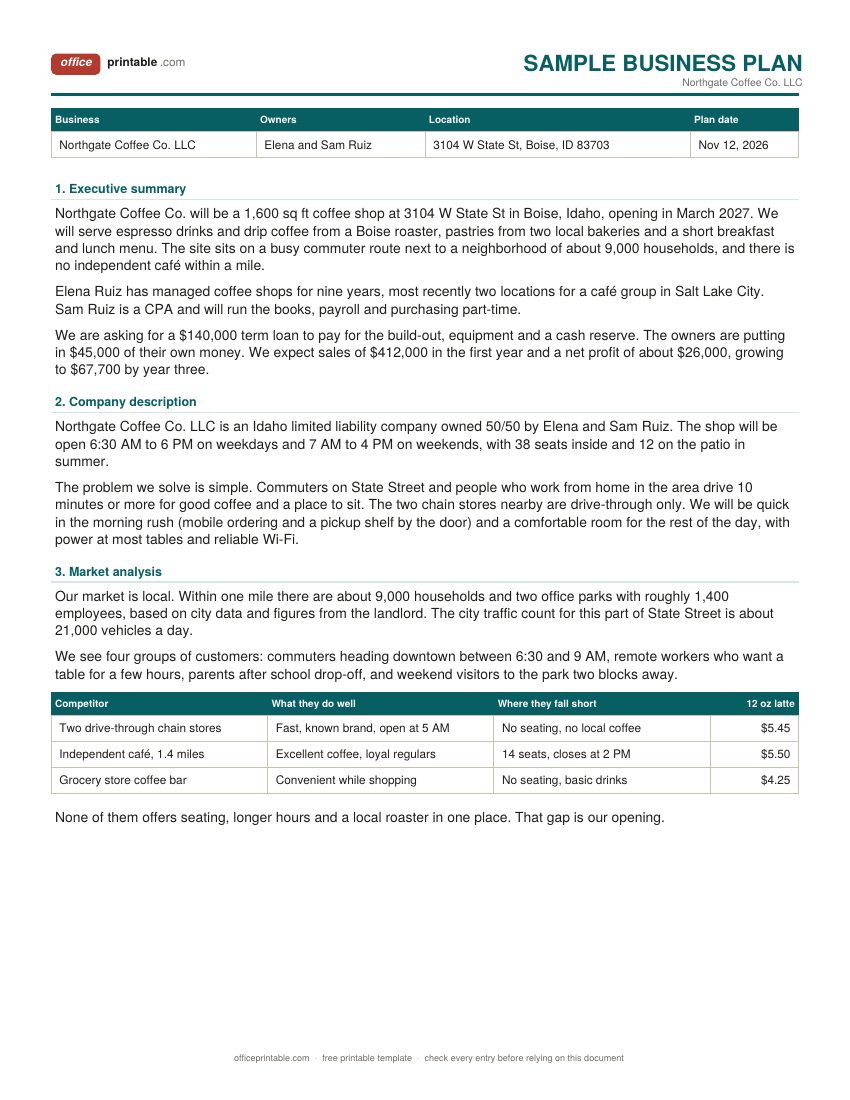
The sample business plan is a complete plan for a fictional coffee shop in Boise, Idaho, written out in every section. It asks for a $140,000 loan, shows $45,000 of owner money, lists the use of funds down to the cash reserve and projects three years of sales and profit. It's there to show the level of detail that makes a plan believable: a traffic count, a competitor table, menu prices with margins, a marketing budget, and assumptions that add up.
The Word version is the easiest to reuse. Open it, keep the headings, and replace the café text with your own, one section at a time. In the PDF the tables can be typed over. All names, addresses and figures in the sample are made up for illustration and aren't a guide to what a café will earn.
Simple business plan template or a full plan?
Not every business needs a long document. The SBA separates traditional plans which can run to dozens of pages, from lean startup plans that fit on one page and take about an hour. If the plan is only for you, or you're testing an idea before you spend money, a short plan is usually enough. Our one-page business plan and business planner covers that, with a monthly planner and a revenue tracker for running the business afterward.
Write the full plan when someone else has to say yes: a bank, an SBA lender, an investor, a landlord for a large lease, or a partner. Lenders and investors often ask for more than a one-pager anyway. A SWOT analysis is a quick way to gather material for the market and competition sections, and the small business checklist covers registrations, licenses and other setup tasks that the plan should mention.
Help with writing and checking a plan is often free. SCORE, an SBA resource partner, offers mentoring at no cost, and the network of nearly 1,000 Small Business Development Centers offers no-cost business consulting. A mentor reading your draft will spot gaps before a lender does.
Business plan template in Word, PDF and Excel
Each design of this free business plan template comes as a fillable PDF for US Letter and A4, a Word file, an Excel workbook, and LibreOffice versions. The Word file is the best choice for a plan you'll send to a lender: the sections are tables you can type into, and you can add pages, a logo or charts. The fillable PDF works in a free PDF reader if you don't have Word. In Excel, enter numbers in the plain cells; the shaded cells hold formulas for margins, totals, cost per customer, net profit, break-even sales and year-end cash. They stay blank until you type in the row, so an empty form prints clean.
Before you send a plan anywhere, check every figure against your own records and quotes. Loan terms, licensing and tax rules vary by state, city and lender, so check with your lender, your accountant or your local SBA office on what they need to see.
Questions
What are the main sections of a business plan?
The SBA lists executive summary, company description, market analysis, organization and management, service or product line, marketing and sales, funding request and financial projections. Most plans add an appendix with supporting documents.
How long should a small business plan be?
Long enough to answer a lender's questions and no longer. The SBA notes that a traditional plan can run to dozens of pages, while a lean startup plan usually fits on one page. Clear numbers matter more than page count.
Do I need a business plan for an SBA loan?
Many SBA lenders ask for one, especially for a new business, along with financial projections and personal financial information. Requirements differ from lender to lender, so ask yours for their list before you start.
How many years of financial projections should a business plan include?
The SBA guide suggests five years, with the first year by month or quarter. Many small business lenders accept three. Start with a realistic first year, because every later year builds on it.
Is there a sample business plan I can copy?
Yes. The sample design is a complete small business plan for a café. Download the Word version, keep the structure and replace the text and numbers with your own.
Does the PDF calculate the forecast?
No. The fillable PDF is for typing only. The Excel and ODS files calculate margins, totals, net profit, break-even sales and cash at year end.
Comments and questions
Have a question about this template, or an idea to make it better? Leave a comment.
Leave a comment