What is on the page
- Header
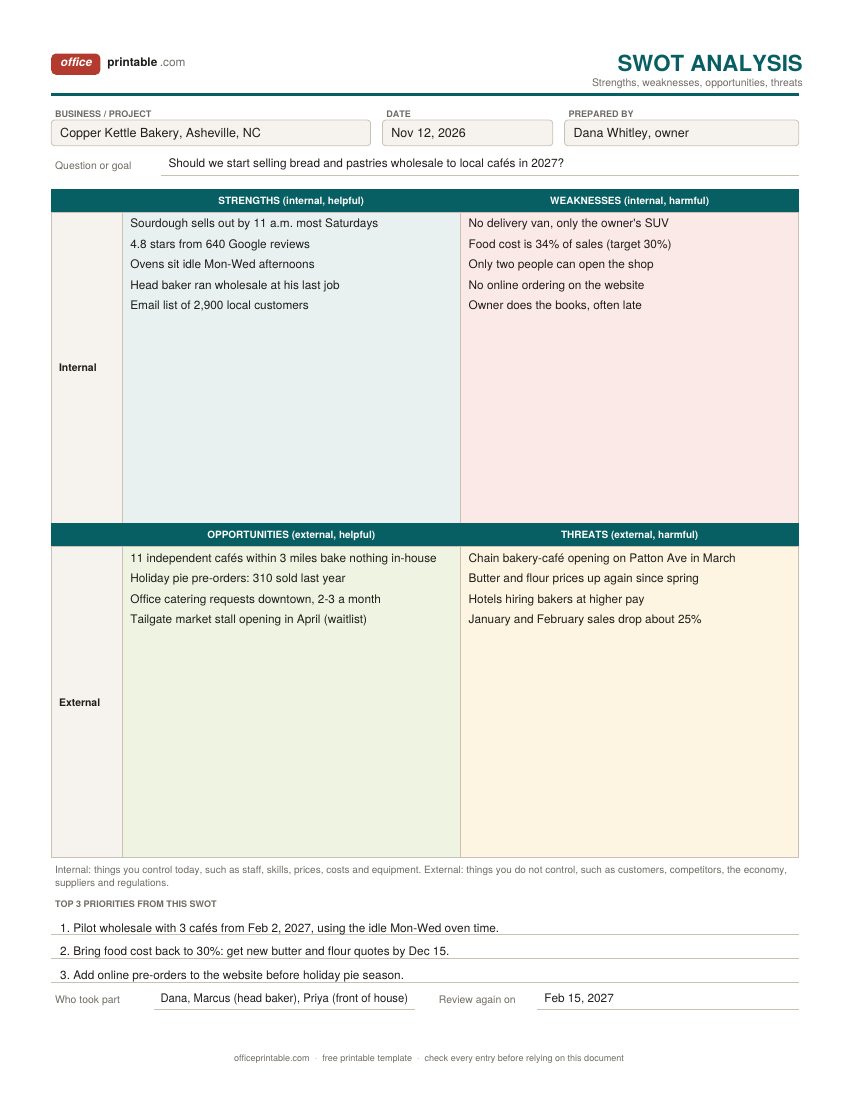
- Business or project name, date and who prepared it. The classic grid also asks for the question you want the SWOT to answer, such as "Should we open a second location?" A SWOT with no question tends to wander.
- Strengths and weaknesses
- Internal factors: what you have or lack today. Skills, reputation, cash, costs, equipment, location, systems, people.
- Opportunities and threats
- External factors: what is happening around you. Customer demand, competitors, prices from suppliers, new rules, the local economy, the season.
- Top priorities
- Three things you will do because of what the grid shows, plus who took part and when you will look at it again.
- TOWS matrix
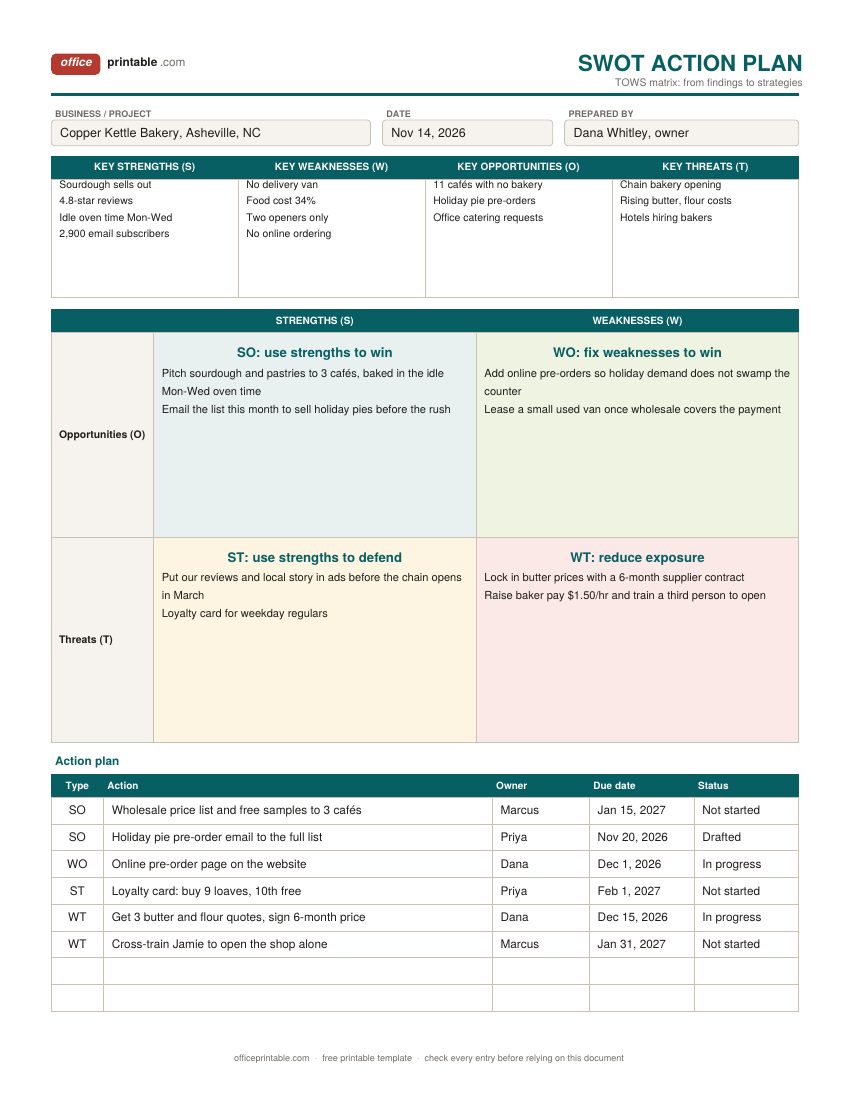
- On the action plan design, four boxes that pair each internal factor with an external one: SO, WO, ST and WT strategies.
- Action plan
- Each strategy becomes a task with a type, an owner, a due date and a status.
- Competitor columns and scores
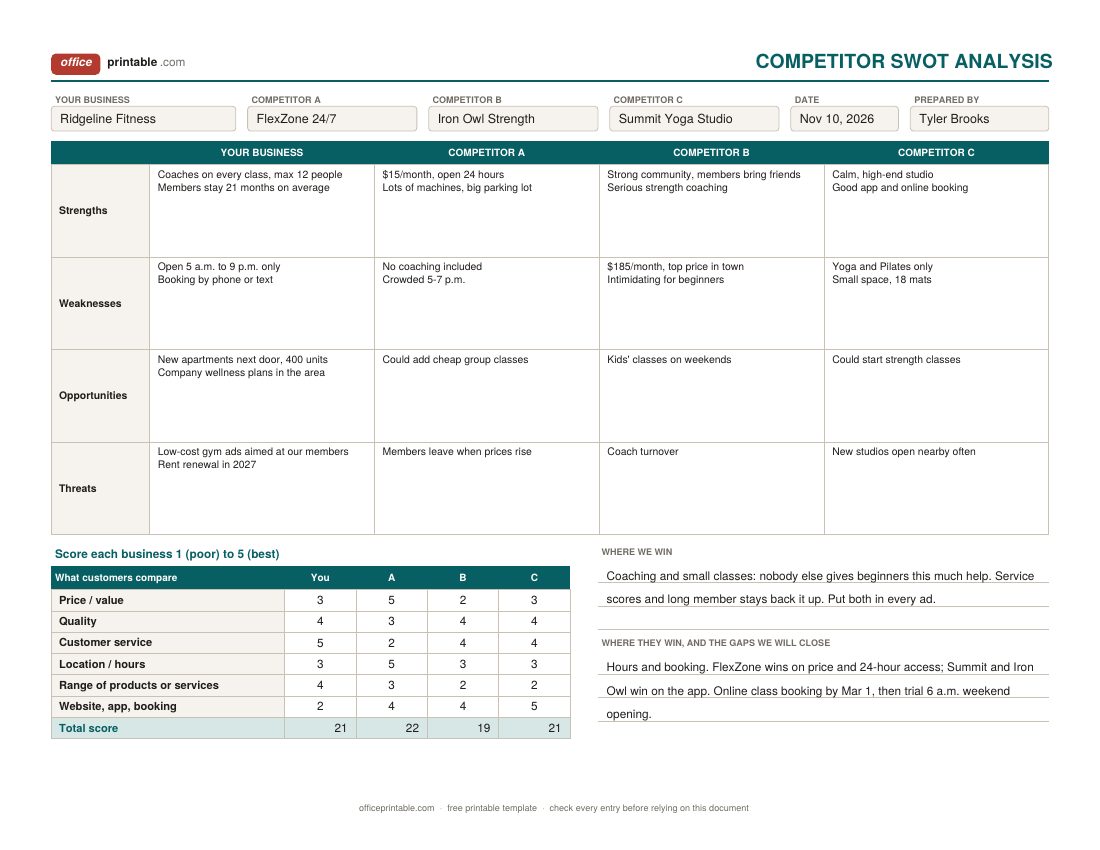
- On the competitor design, a SWOT for your business and three rivals, a 1 to 5 score on what customers compare, and totals worked out in Excel.
What a SWOT analysis is, with a short example
SWOT stands for strengths, weaknesses, opportunities and threats. The idea came out of business strategy work in the 1960s and it has stuck around because it is simple: you sort what you know about a business, a project or yourself into four boxes, then look at how they fit together.
Take the bakery on the sample. Its sourdough sells out every Saturday and its ovens sit idle three afternoons a week (strengths). It has no van and its food cost is too high (weaknesses). Eleven nearby cafés buy bread from somewhere else (opportunity), and a chain bakery-café is opening down the street in March (threat). Put side by side, the obvious move is a small wholesale trial using the spare oven time, while fixing costs before the chain arrives. That's the whole point of a SWOT: one page that makes the next decision clearer.
How to run a SWOT session
- Write the question first. "Should we add wholesale?" or "Where should we spend next year's marketing budget?" Fill it in at the top of the SWOT template.
- Pick the right people. Three to six is a good number. Bring someone who talks to customers every day and someone who sees the numbers.
- Collect ideas quietly first. Give everyone ten minutes to write entries on their own, then share. This stops the loudest person from setting the agenda.
- Sort and trim. Group duplicates, argue about which box each item belongs in, and cut each box to its five most important entries.
- Ask "so what?" For every entry, ask what it means for the question. Anything without an answer can go.
- Choose three priorities and give each an owner. If the SWOT ends with no tasks, it was a discussion, not an analysis.
An hour is usually enough for a small business. Book a review date, because a SWOT goes stale as soon as the market moves.
Good vs vague SWOT entries
Most SWOT charts fail because the entries are too general to act on. "Great customer service" could be written by any business in the country. Compare these:
- Vague: "Strong brand." Better: "4.8 stars from 640 Google reviews, most of them mention the sourdough."
- Vague: "Cash flow." Better: "January and February sales drop about 25 percent, and we have two months of rent in reserve."
- Vague: "Competition." Better: "A chain bakery-café opens on Patton Ave in March, two blocks away."
- Vague: "Growing market." Better: "11 independent cafés within 3 miles bake nothing in-house."
A good entry is specific, has a number or a name in it where possible, and is something the people in the room would agree is true. If you can't point to evidence, write it as a question and go find out.
Internal vs external factors
The rule that sorts the boxes: strengths and weaknesses are internal, so you control them now. Opportunities and threats are external, so they happen even if you do nothing. "We have no online ordering" is a weakness. "More customers expect to order online" is an opportunity, or a threat if a competitor gets there first.
A common slip is putting your own plans in the opportunities box. "Launch a new website" is an action, not an opportunity. The opportunity is the outside change that makes the website worth building. Keep actions for the priorities box and the action plan.
From SWOT to action: the TOWS matrix
The TOWS matrix was described by Heinz Weihrich in 1982 as a way to turn SWOT findings into strategy. It pairs the boxes: SO strategies use strengths to grab opportunities, WO strategies fix weaknesses that stop you taking an opportunity, ST strategies use strengths to defend against threats, and WT strategies limit the damage where a weakness meets a threat.
On the action plan design, copy your top few entries from each box into the top row, write one or two strategies in each quarter of the matrix, then move the best ones into the action table with an owner and a due date. If there are more ideas than time to do them, rank them on a task priority matrix. Bigger projects can go into your business plan or a one-page business planner, and threats with real cost attached belong on a risk register.
Competitor analysis template: SWOT side by side
A competitor SWOT shows the same four boxes for you and for two or three businesses your customers would otherwise choose. Pick competitors by what customers actually compare you with, not just who is biggest. For a small gym, that might be a cheap 24-hour chain, a strength studio and a yoga studio.
Fill in their boxes from what you can see: their website and prices, online reviews, social media, job ads and a visit if you can make one. Reviews are useful because customers tell you exactly what they like and what annoys them. Then score everyone 1 to 5 on the things customers weigh up. Excel adds the totals, but the pattern matters more than the total. In the sample, the gym loses on price and hours and wins clearly on coaching, so its ads should lead with coaching while it fixes online booking. If you're comparing software or suppliers rather than rivals, the CRM comparison checklist is a better fit.
Personal SWOT analysis template
The classic grid works just as well for a person. Use it before a job search, a performance review or a decision about going freelance. Strengths are skills, experience and things people ask you for help with. Weaknesses are gaps you would rather not mention in an interview. Opportunities are things like open roles, a growing field, a training budget or a contact who could introduce you. Threats are layoffs in your industry, automation of part of your job, or a certification you lack that new hires now have.
Ask a colleague or friend to fill in your strengths separately. People are often poor judges of their own strong points. Then write three priorities, like any other SWOT, with dates.
Common SWOT mistakes
- Twenty items in each box. Nobody acts on a list that long.
- Mixing up internal and external, so the boxes stop meaning anything.
- Only the owner's view. Staff and customers often see weaknesses the owner has stopped noticing.
- Being too kind. A SWOT that's all strengths is a brochure.
- No follow-up. The grid gets filed and nothing changes. Move the priorities into your marketing planner or task list straight away.
- Using it once. Review the SWOT every six to twelve months, or sooner when something big changes. If the weaknesses point to a broken process, a process improvement worksheet is the natural next step.
Editing the SWOT template in Word and Excel
The PDFs are fillable, so you can type straight into each box and save or print. The SWOT analysis template in Word is handy when you want to change the headings, add your logo or paste the grid into a report. The Excel files keep each box in its own cell, and on the competitor design the score totals update as you type. ODT and ODS copies open in LibreOffice and Google Docs or Sheets.
Questions
What is a SWOT analysis template?
A one-page form with four boxes for strengths, weaknesses, opportunities and threats. You fill it in to see where a business, project or person stands before making a decision.
What is the difference between SWOT and TOWS?
They use the same four lists. SWOT describes the situation. TOWS pairs the lists to produce strategies: SO, WO, ST and WT.
How many items should go in each SWOT box?
Three to five is a good target. If a box runs longer, keep the entries that matter most to the question you are trying to answer.
Can I use a SWOT template for competitor analysis?
Yes. The competitor design puts your business and up to three competitors side by side, with a score table for the things customers compare.
Is there a personal SWOT analysis template?
Use the classic grid. Write your name in the header and a career question such as "Should I apply for the team lead role?" as the goal.
How often should a business do a SWOT analysis?
Once or twice a year works for most small businesses, plus any time something big changes, like a new competitor, a price jump from a supplier or a plan to expand.
Comments and questions
Have a question about this template, or an idea to make it better? Leave a comment.
Leave a comment