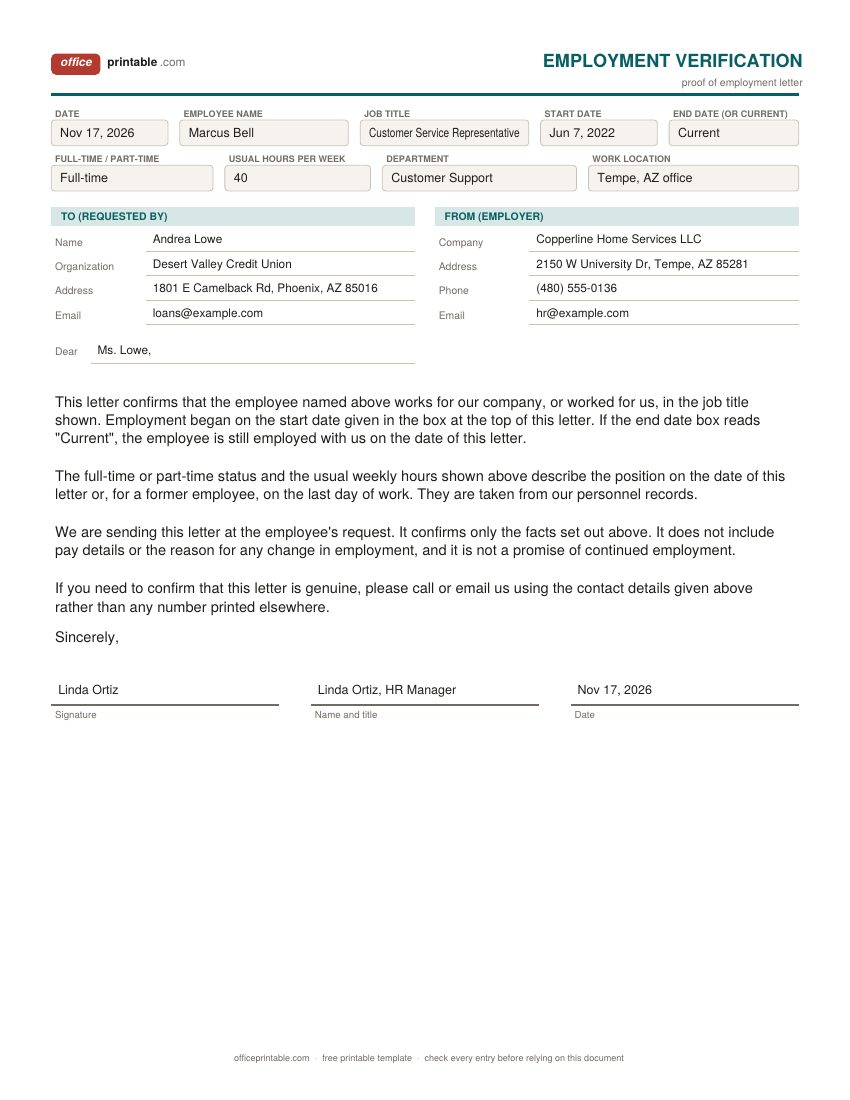
What is on the page
- Date
- The day the letter is signed. Lenders and landlords often want a letter dated within the last few weeks, so date it when you send it, not when you started writing it.
- Employee name and job title
- Use the name and title as they appear in payroll. A different spelling from the one on the applicant's ID or pay stubs can hold up a rental or loan file.
- Start date and end date
- Write "Current" in the end date box for someone still on staff. For a former employee, give the last day worked.
- Status and hours
- Full-time or part-time, with the usual weekly hours. Leave the hours blank if they vary a lot and say so in the letter.
- To and From
- Who asked for the letter and who is sending it. The employer's phone and email let the reader call back to confirm the letter is real.
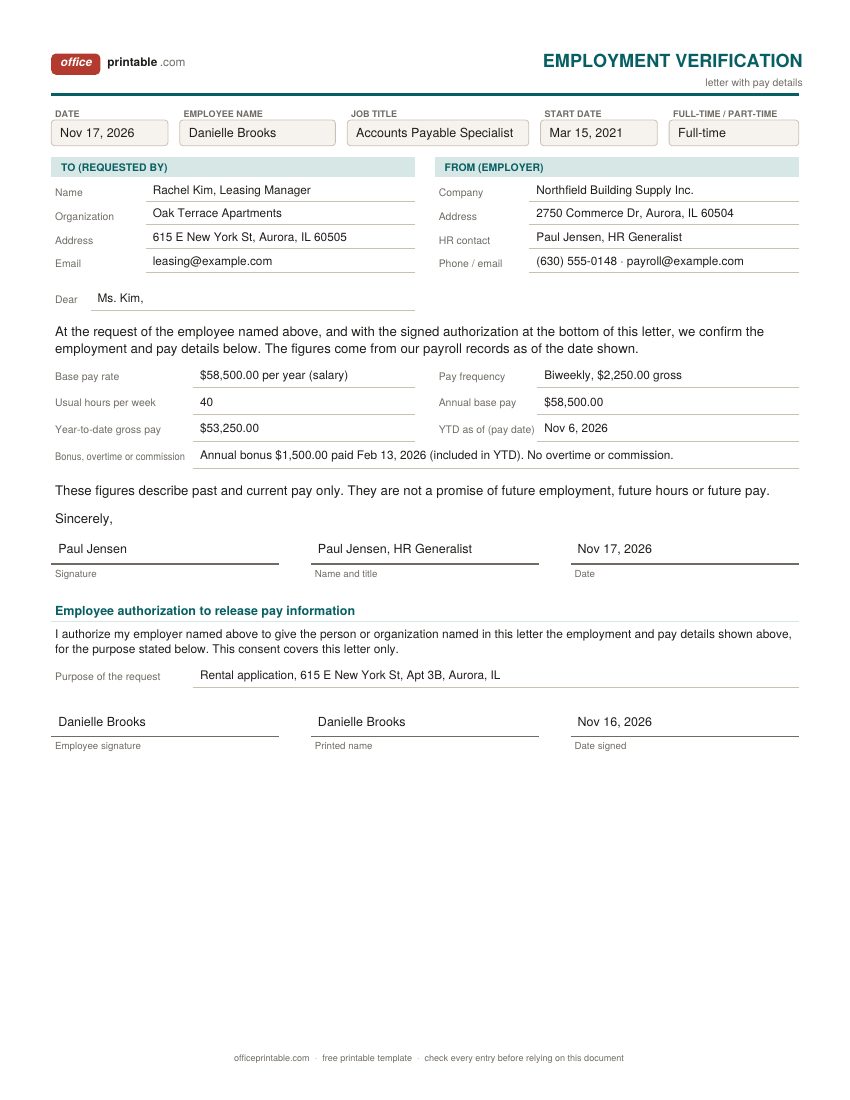
- Pay details
- On the pay details design only: base rate, pay frequency, annual base pay, year-to-date gross and any bonus or overtime.
- Employee authorization
- The employee signs to allow the release of pay information for one stated purpose. Keep the signed copy in the personnel file.
- Signature
- Signed by someone in HR, payroll or management who can stand behind the facts, with a printed name and title.
How to write an employment verification letter
- Check who is asking and what they need. Many requests only need dates and a job title. Pay figures should go out only when the employee asks for them in writing.
- Pull the facts from payroll, not from memory: legal name, title, start date, status and, if needed, pay.
- Fill in the boxes at the top of the letter. The body text refers to those boxes, so you do not have to repeat a single date in the wording.
- Add the requester's name and address and your company's contact details. A phone number and email that the reader can check against your website make the letter easier to trust.
- Sign it, keep a copy and send it straight to the requester or give it to the employee, whichever was agreed.
Print it on company letterhead if the business uses one. In the Word file you can delete the From box and put the letterhead at the top of the page instead.
Which employment verification letter template to use
The standard letter covers most requests. A new employer checking a resume, a school, a government office or a background check company usually wants to know that the person worked there, in which role and for how long. Nothing more needs to go out.
The letter with pay details is for landlords, lenders and car dealers who have to see income. It carries the pay rate, pay frequency, annual base pay and year-to-date gross, with room for bonus or overtime. The consent strip at the bottom is signed by the employee before the letter is sent. Some landlords also ask for recent pay stubs; if your payroll system doesn't print them, the pay stub template can help.
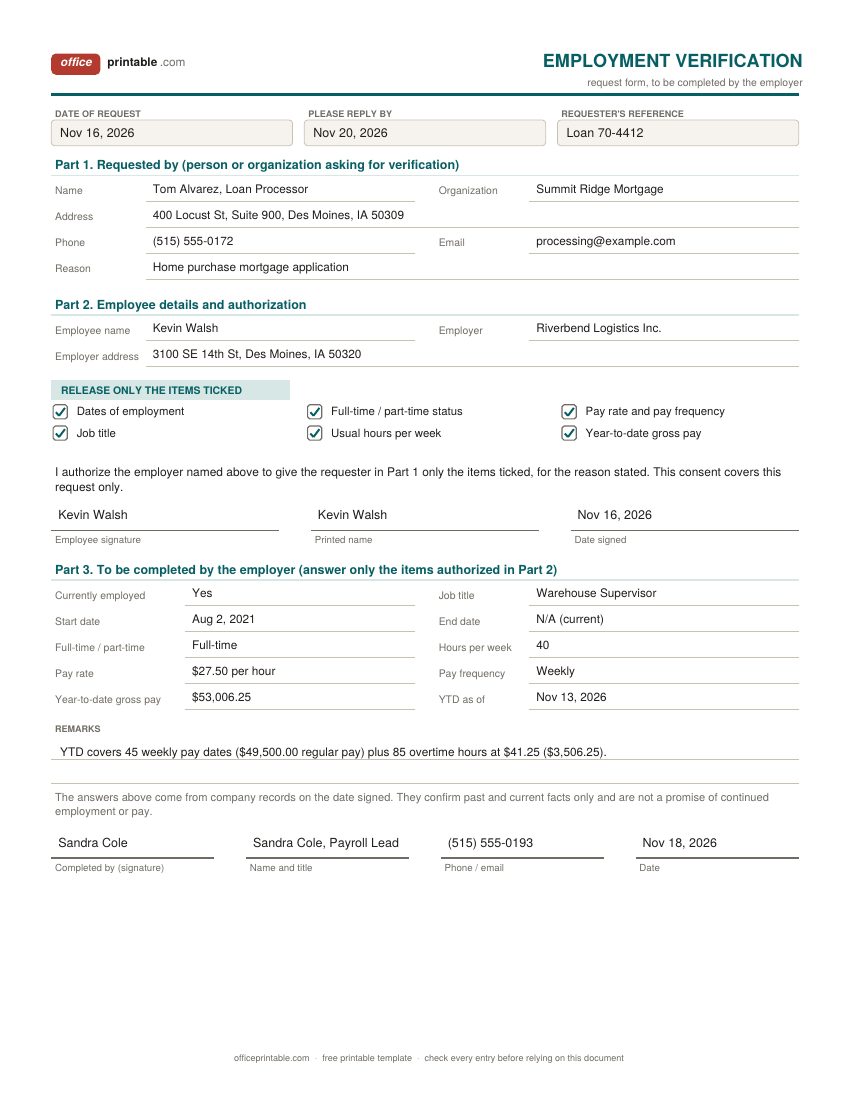
The verification request form works the other way round. The landlord or lender fills in Part 1, the employee fills in and signs Part 2, and HR completes Part 3. It saves a phone call, and the employer answers only the items the employee ticked.
If you are the employee asking for a letter
Most people need a proof of employment letter at short notice: a rental application with a deadline, a loan that's about to close, a new job that wants to check your history. Ask HR or your manager early and tell them three things: who the letter is for, what it needs to show (dates only, or pay as well), and how it should be delivered.
You can make it easier by sending this template with the boxes already filled in where you know the answers, and the To section completed. HR then only has to check the facts against payroll, add the pay figures if you have authorized them, and sign. If your employer uses an outside verification service or has its own form, it will tell you; follow that instead.
While you're at it, check that HR has your current legal name and address. A quick update on an employee information form avoids a mismatch between the letter and your ID.
What an employment verification letter can include, and what to leave out
A basic proof of employment letter confirms the facts: name, title, dates and status. Many employers have a policy of giving nothing more without written consent, and that's a sensible default. Pay details, the reason someone left and anything about job performance are more sensitive and should only go out when the employee has authorized it.
Keep these out of a verification letter:
- Social Security numbers, dates of birth and home addresses, unless the request clearly needs them and the employee agreed.
- Health, medical leave, disability or family details.
- Opinions about the employee's work, attitude or attendance. That belongs in a reference, if your company gives references at all.
- Predictions about future pay, raises or job security.
Rules on what an employer may or must share differ from state to state. Kansas, for example, requires an employer to give a former employee who asks for one a letter stating the dates of employment, job classification and wage rate. Check your company policy and your state labor department's guidance before you set a standard practice.
Employment verification for a mortgage or rental
Mortgage lenders usually verify employment more than once. Many ask for a written verification early in the process and then check again by phone shortly before closing. For loans sold to Fannie Mae, the lender has to confirm the borrower's employment no more than 10 business days before the note date which is usually the closing date. So if a lender calls HR a few days before a closing, that's normal; answer it with the same facts the letter gave.
Landlords are usually less formal. Many accept a signed letter with pay details plus a couple of recent pay stubs. Some will call the number on the letter which is one more reason to use a main company phone line and not a personal cell number.
Keeping records
File a copy of every verification letter you send, together with the signed employee authorization, in the personnel file. It shows what was released, to whom and with what consent. When someone joins, a line about how verification requests are handled can go on your employee onboarding checklist. When someone leaves, the offboarding checklist is a good place to confirm the forwarding contact details you will need for future requests. An employee who has just handed in a resignation letter may well ask for a verification letter for a new landlord within weeks.
The text in these templates is a starting point, written in general terms. Errors in a template like this can happen, whether unintentional or intentional, so check every name, date and figure against your own records and follow your company policy and state law before you rely on it.
Questions
Is an employer required to give an employment verification letter?
There's no general federal rule that makes an employer write one. Most do it as a courtesy because employees need them for housing and loans. A few states require a letter on request for former employees, usually limited to dates, job title and pay, so check your state law.
Who should sign an employment verification letter?
Someone who can confirm the facts from company records, usually an HR manager, payroll lead, office manager or the owner of a small business. Add a printed name, title and a phone number the reader can call.
Can I write my own employment verification letter?
You can prepare it, but it should be checked and signed by your employer. A letter signed by the employee alone doesn't verify anything. Filling in the template and handing it to HR saves them time.
Should the letter include salary?
Only when the employee asks for it and signs a consent. The standard letter leaves pay out on purpose. Use the pay details design when a landlord or lender needs income figures.
How long is an employment verification letter valid?
It has no set expiry date. Lenders and landlords usually want a recent letter, often one dated within the last month or so, and a mortgage lender may check again just before closing. Ask the requester what they accept and issue a fresh letter if needed.
Can I email the letter instead of mailing it?
Yes. A signed PDF sent from a company email address is common. Send it to the requester directly when you can, and keep a copy with the employee's authorization.
Comments and questions
Have a question about this template, or an idea to make it better? Leave a comment.
Leave a comment