What is on the page
- Seller and buyer
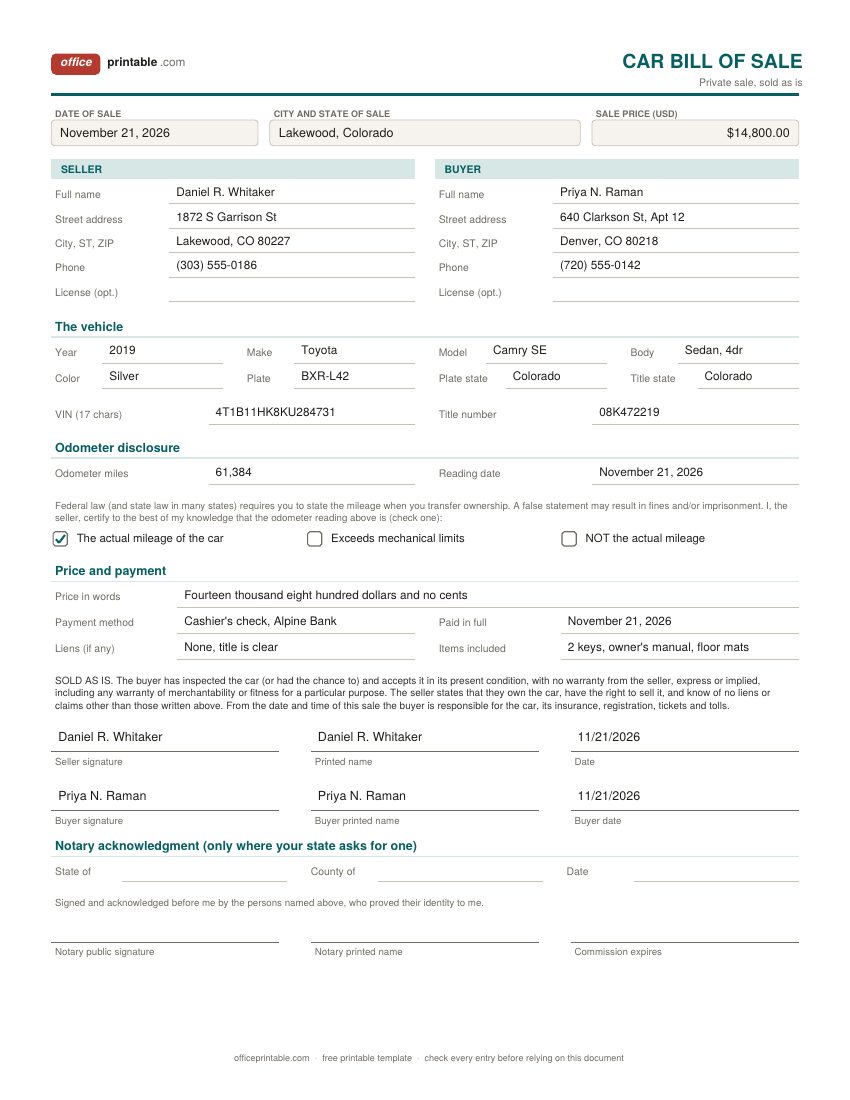
- Full legal names as shown on a driver's license, with address and phone. The seller's name should match the title, and if two people are on the title, both sign. The license number is optional.
- Year, make, model and body
- Copy them from the title or registration card, not from the ad. "2019 Toyota Camry SE, sedan" has to agree with what the VIN says when the DMV runs it.
- VIN
- The 17-character vehicle identification number. It never contains the letters I, O or Q, which is a quick way to catch a typo.
- Title number and plate
- The title number is on the front of the title. Add the plate and its state so the seller can point to the exact car if a ticket turns up later.
- Odometer reading
- The miles on the dash on the day of sale, without tenths, and one tick box: actual, exceeds mechanical limits, or not the actual mileage.
- Price and payment
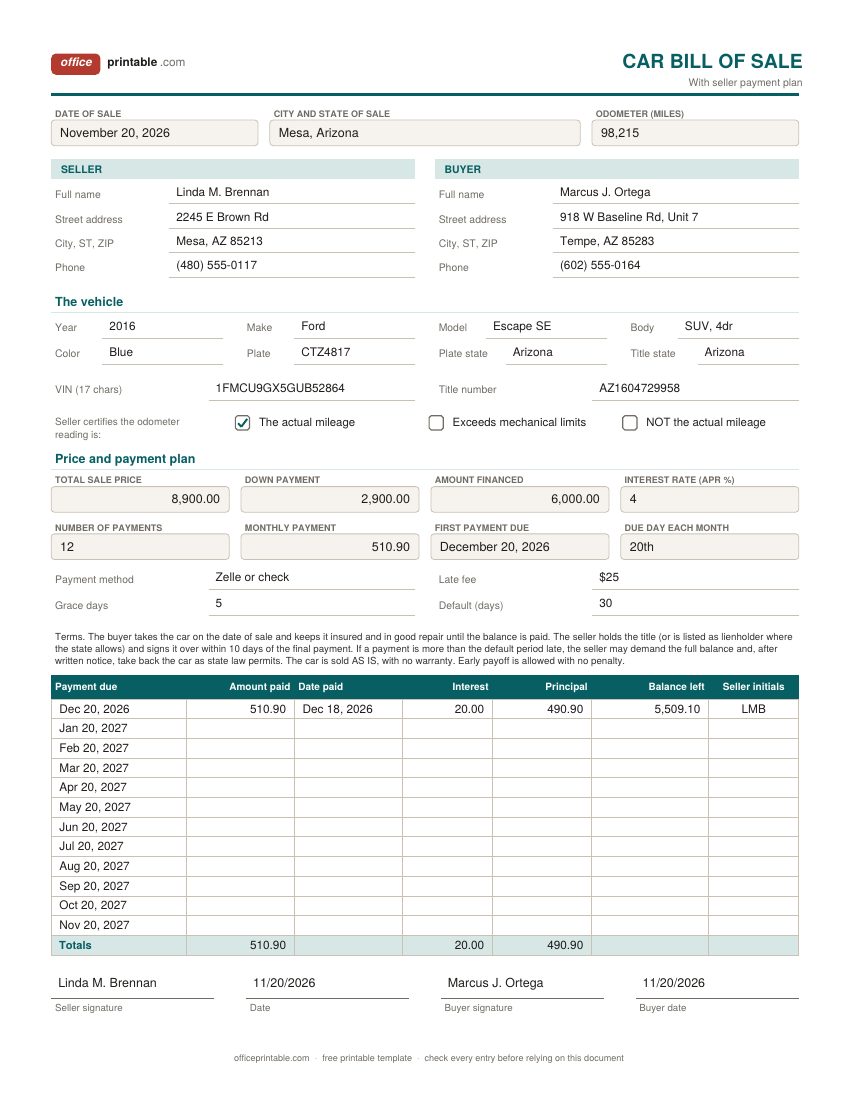
- The real price in figures and words, how it was paid and when. The payment plan version adds the down payment, amount financed, rate, monthly payment and a payment record.
- As-is clause
- The buyer accepts the car in its current condition with no warranty, and the seller confirms they own it and lists any liens.
- Signatures and notary
- Both sides sign, print and date. The notary section is for states that want one; leave it blank elsewhere.
Which car bill of sale to use
- As is: the usual private sale. The buyer pays in full on the day and drives away. Most people need this one.
- Payment plan: the buyer pays part now and the rest to the seller each month. It covers the down payment, interest (if any), late fee, default and who keeps the title till the last payment.
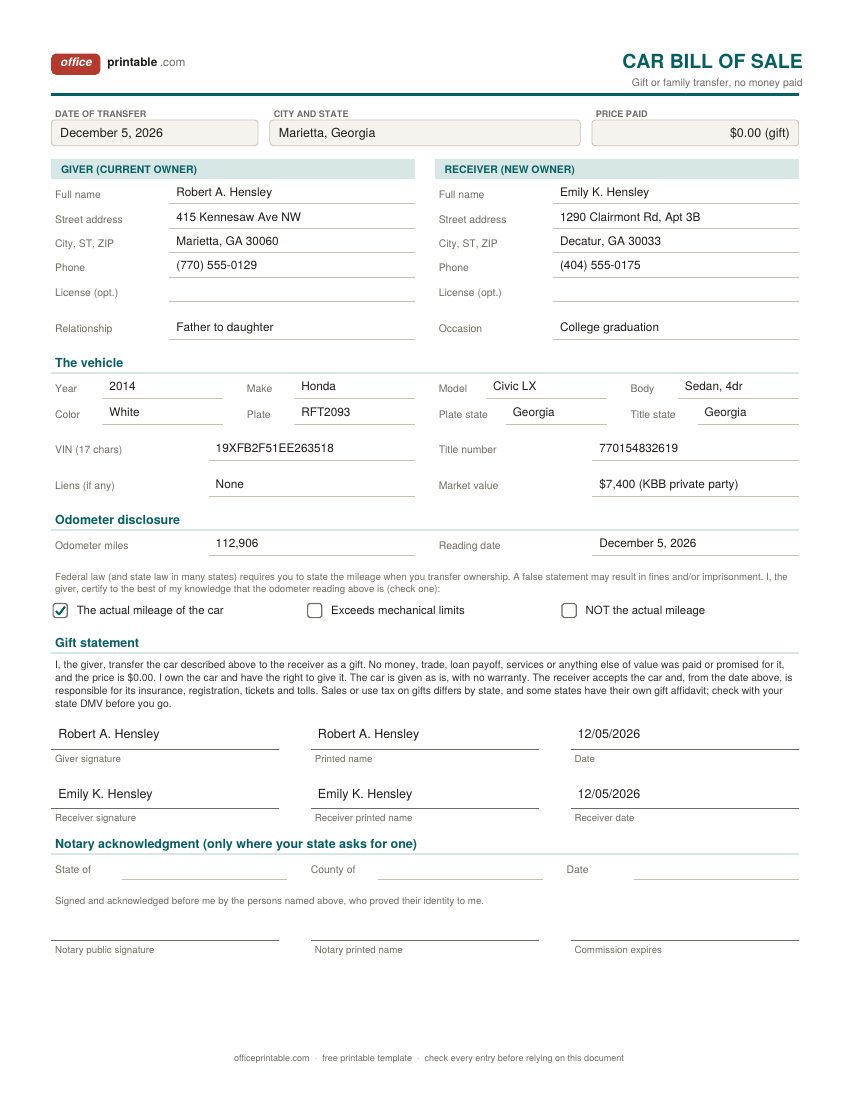
- Gift or family transfer: no money changes hands, such as a parent passing a car to a son or daughter, or a car moved between spouses.
These forms are for cars, pickups, SUVs and vans. For a boat with its motor and trailer, or for furniture, tools and other personal property, use the general bill of sale template instead. This is a general form and not legal advice; laws differ by state, so check your state's DMV before you rely on it.
Does a car bill of sale replace the title?
No. The certificate of title is the ownership document. The seller signs it over, fills in the title's odometer section if it has one, and the buyer takes it to the DMV for a new title and registration. A vehicle bill of sale sits next to the title. It proves the price (which many states use for sales tax), the date responsibility changed hands, and what both sides agreed.
Some states require a bill of sale for every private sale, some only when the price isn't on the title, and some have their own form you must use. If yours does, fill that in and keep this auto bill of sale as the fuller record.
Finding the VIN and checking it
Look through the windshield at the lower driver-side corner of the dashboard, then check the sticker on the driver's door jamb. Both should match the title, the registration and the insurance card. If they don't, stop and ask why before any money moves.
Buyers should run the VIN through the free NHTSA recall lookup and a history report before paying. There's never an I, O or Q in a VIN, so a character that looks like an "O" is always a zero. One wrong character is enough for a clerk to send you home.
The odometer disclosure, explained
Federal law requires the seller to state the mileage in writing when ownership changes. Since January 1, 2021, the rule covers model year 2011 and newer vehicles until they are 20 years old, so a 2011 car needs a disclosure through 2030. Model year 2010 and older vehicles stayed on the old 10-year rule and are now exempt from the federal requirement, though some states still ask for the reading.
Write the miles as shown, without tenths, and tick one box. "Actual mileage" is the normal answer. "Exceeds mechanical limits" is for old five-digit odometers that rolled past 99,999. "Not the actual mileage" is for a replaced cluster or a known fault, and many states brand the title because of it, so be sure before you tick it. If the title has its own odometer section, complete that too.
What "as is" means in a used car sale
Most private car sales are as is. The buyer gets the car in the condition it is in on the day, with no promise that it will keep running. If the transmission fails a week later, that is the buyer's problem, and the written clause protects the seller from a buyer who later says "you told me it was perfect".
It does not cover a lie. A seller who hides a flood title or a rolled-back odometer isn't protected, so disclose what you know. If the seller does promise something, say new tires before pick-up, write it on the form above the signatures.
How to sell a car privately, step by step
- Find the title and check it's in your name with no open lien. If there's a loan, ask the lender how payoff and title release work.
- Agree the price and let the buyer inspect the car, ideally with a mechanic. Buyers comparing several cars can use the vehicle purchase comparison worksheet, and a seller who kept a vehicle service log can hand it over as proof of care.
- Fill in the bill of sale together, make two copies, and both sign. Notarize if your state wants it.
- Sign the title over exactly as your state instructs, with no crossing out or correction fluid.
- Deal with the plates. In many states they stay with the seller; Texas, for example, lets the seller take them off.
- File the release of liability or notice of sale. California expects it within 5 days, and Texas sellers file a vehicle transfer notification.
- Call your insurer after the sale. The buyer needs their own cover before driving away; the car insurance comparison checklist helps with quotes.
- Buyer registers the car within the state deadline. California allows 10 days, Texas 30 and Montana 40, for example.
Getting paid safely
For cash, count it together and think about meeting at the buyer's bank, where staff can check the bills. For larger sums a cashier's check is common: call the issuing bank on a number you look up yourself and confirm the check before you sign the title. A wire that has landed in your account is safe; a screenshot of one is not.
Meet in daylight in a busy place. Hand over the keys and title only after the money is in your hands or your account. If a deposit was paid on an earlier day, give a payment receipt or a simple receipt for it.
Mistakes that cause trouble at the DMV
- Writing a lower price "to save on tax". The form is a signed statement, and some states compare prices with book value.
- A VIN with a wrong digit, or one copied from the ad.
- No odometer reading, or two boxes ticked.
- Only one owner signing when two names are on the title.
- No date of sale, the one detail that settles who owes a toll or a parking ticket.
- Handing over the title before the payment has cleared.
Notarization, gifts and state differences
Most states don't need a notary for a car bill of sale, but a few want notarized signatures somewhere in the transfer. Ohio and Montana, for example, have the seller sign the title in front of a notary, and West Virginia asks for a notarized bill of sale when a car sells for less than half its book value. Rules change (Maryland dropped its notarized bill of sale rule for private sales in October 2026), so check your DMV page the week you sell.
Gifts differ too. Many states charge little or no sales tax when a car passes between close family but may want a gift affidavit. Texas charges a flat $10 gift tax for transfers from certain relatives. Ask your state DMV what it needs before the visit.
Editing the Word and Excel files
The PDFs are fillable: type, save and print two copies. In Word each section is a table, so you can add a line or delete the notary block. The Excel copy of the payment plan works out the amount financed and the monthly payment, then carries the balance down the payment record as payments are entered. For a longer plan, the loan amortization schedule shows every payment in advance. More car paperwork is in the vehicle templates section, and other forms are under business forms.
Questions
Is a handwritten car bill of sale legal?
In most states, yes, if it names the seller and buyer, describes the car with its VIN, states the price and date, and is signed. A typed form is just easier for a DMV clerk to read.
Does a car bill of sale need to be notarized?
Usually not, but a few states want notarized signatures on the title or the bill of sale in some sales. Check your state DMV first; the notary section is there if you need it.
Who keeps the bill of sale?
Both of you. The buyer needs it for the DMV and the insurer, and the seller keeps a copy to prove when the car left their hands.
Can I sell a car with a loan still on it?
Yes, but the lender holds the title or a lien. The usual way is to meet at the lender's branch, have the buyer pay off the loan and pay you the rest, and let the lender release the title. Write the lien on the form.
What price do I write on a gift?
Write $0 and use the gift version, which states that nothing was paid. If your state asks for the car's value, an online private-party value is a fair figure.
How soon does the buyer have to register the car?
It depends on the state, often 10 to 30 days and sometimes longer. Late transfers can bring a penalty, so check the deadline on the state DMV site on the day of sale.
Comments and questions
Have a question about this template, or an idea to make it better? Leave a comment.
Leave a comment